Building on the ASP pillar:

Action is committed to acting responsibly, with respect for people and the environment, and to making sustainability accessible every day for our millions of customers. Working at such a scale with our many suppliers and business partners means we can collaborate on sustainable improvements to products, packaging and processes.
Our ambitions are set out in the Action Sustainability Programme (ASP). Inspired by the UN’s 2030 Sustainable Development Goals and the European Green Deal, this ongoing programme is based on four pillars: People, Planet, Product and Partnership, each with its own clear goals and priorities.

Our colleagues are the beating heart of Action. We offer stable employment to a fast-growing number of people. We support our colleagues by providing teamwork, and growth and learning opportunities, so we can reach our potential regardless of our backgrounds.

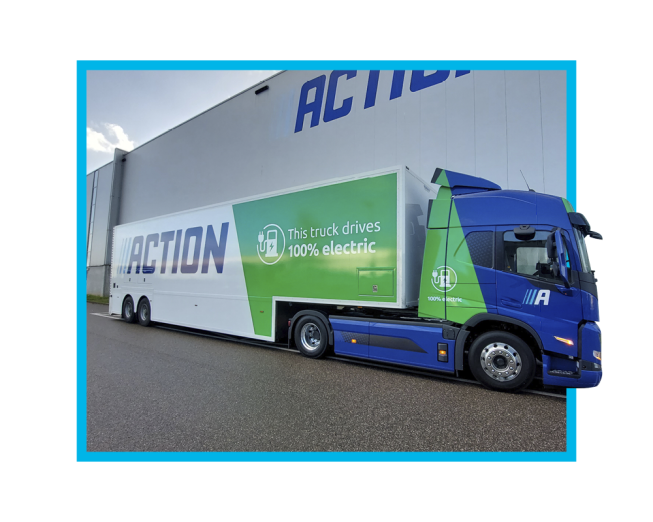
We are committed to reducing greenhouse gas (GHG) emissions across our value chain. Our near-term science-based emissions targets are validated by the Science Based Targets initiative and in line with the Paris Agreement’s objective of limiting global warming to 1.5°C.

We continually invest in the quality and sustainability of our products and in making our value chain more transparent to uphold our ethical sourcing standards, buying only from suppliers who respect human and labour rights.
We are closely connected to the communities in which we work and contribute to their wellbeing where possible. We focus on helping children because we believe all children have the right to grow up in a safe and loving environment.

Building on the
ASP pillar People
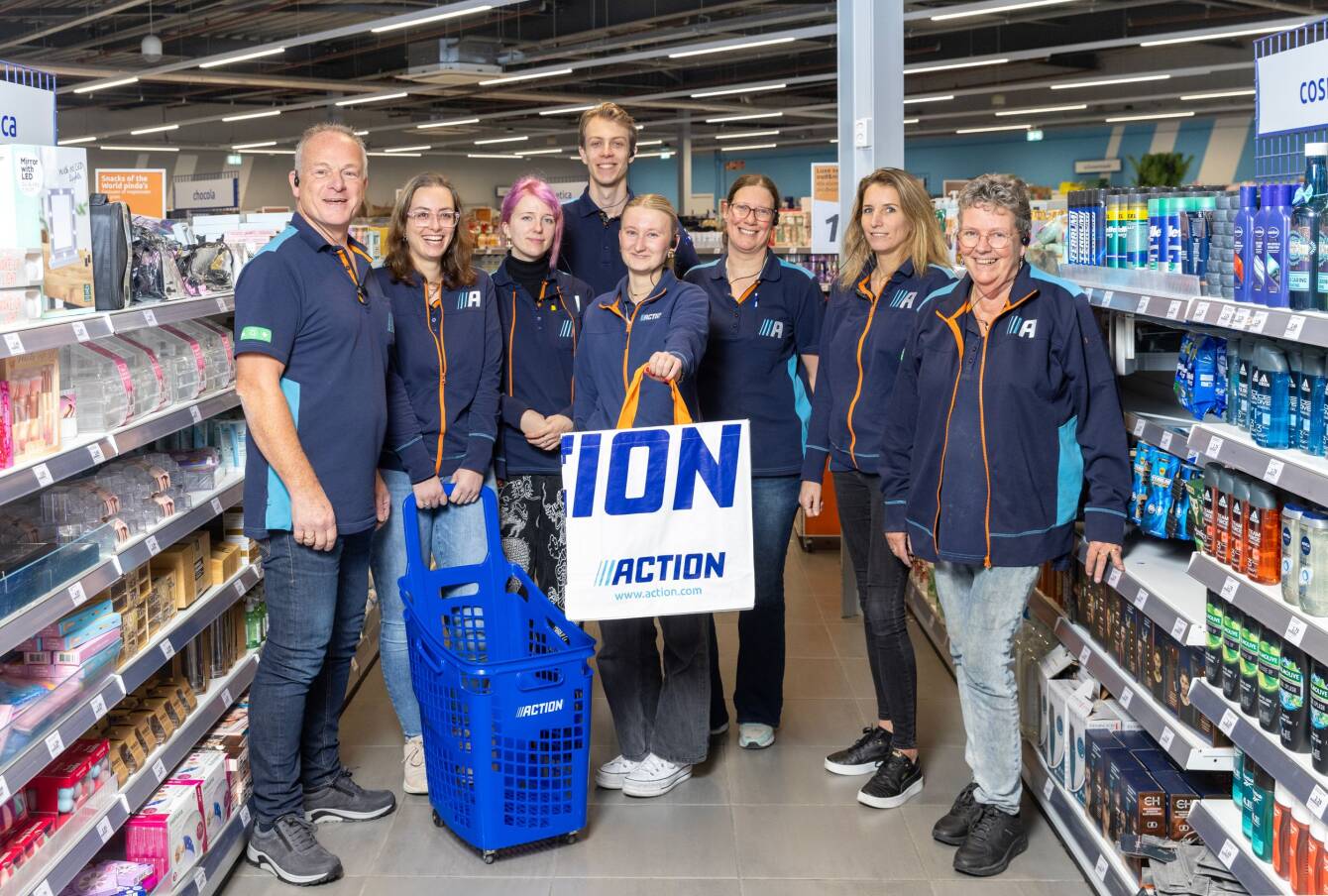
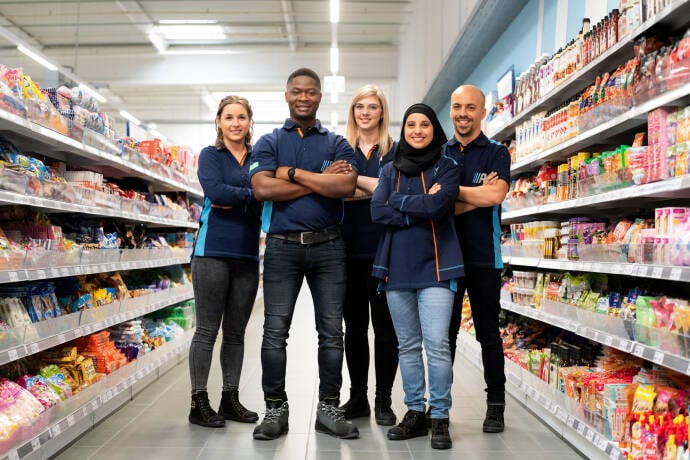
From just one store in 1993, we have grown to more than 3,300 stores by the end of 2025, mainly thanks to the hard work, skills and commitment of our colleagues. Every day, these colleagues contribute to a work environment based on teamwork and respect, where everyone is welcome, regardless of their background.
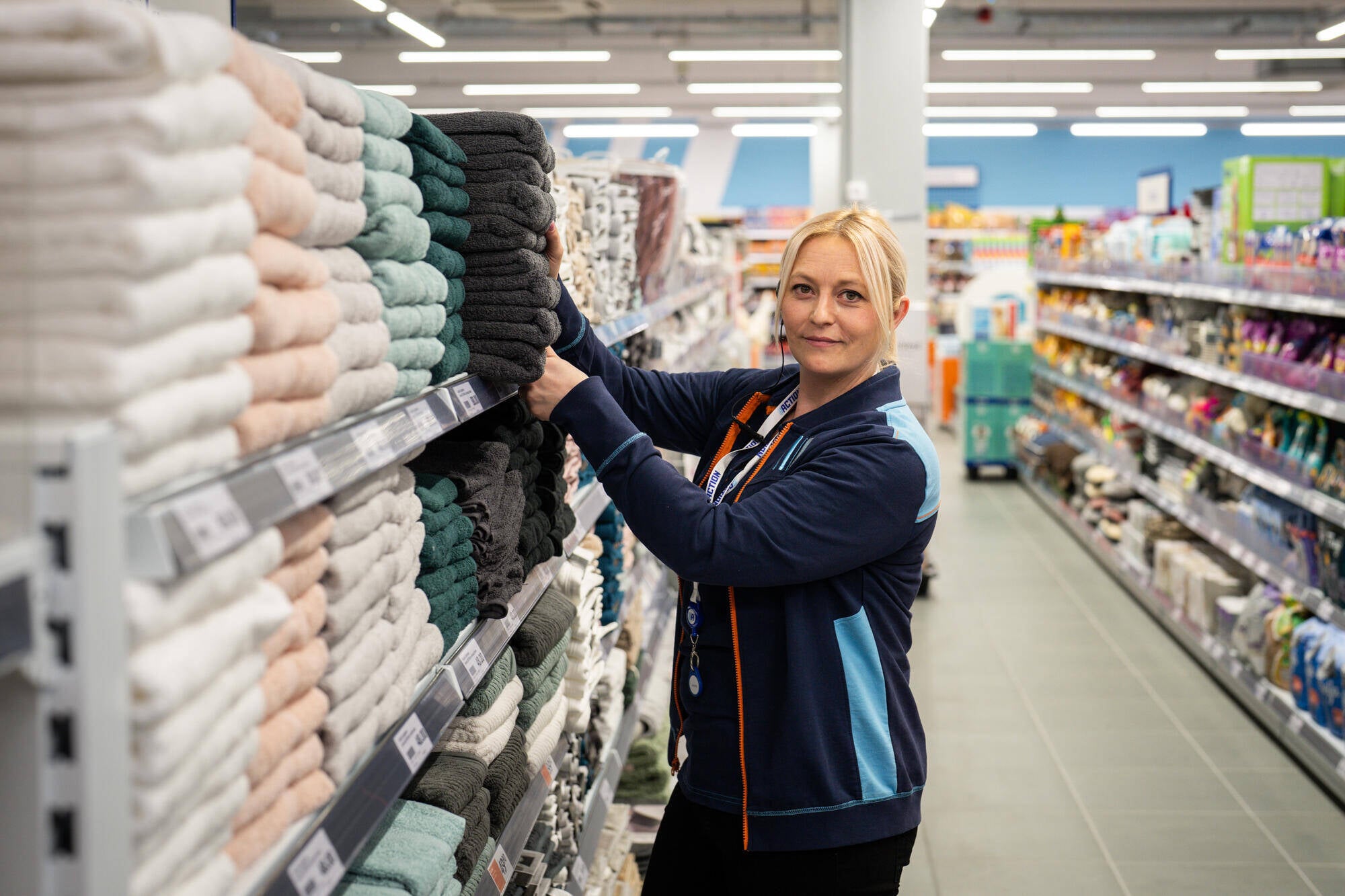
During 2025, Action colleagues spent an average of 4.2 hours in training and development, achieving our target for the year.
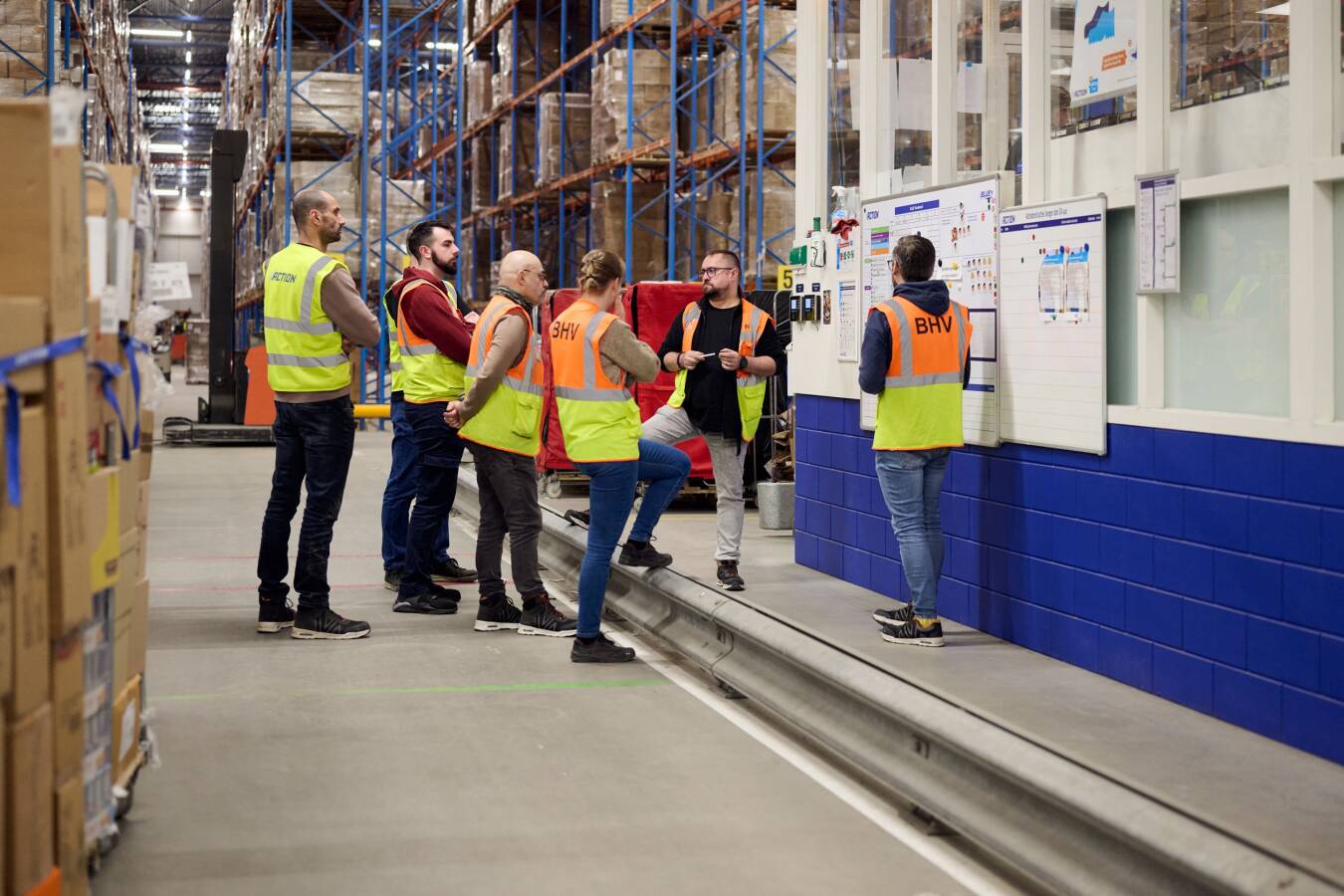
Our workforce reflects the communities we serve. We are committed to providing access to training, career development and giving the support our colleagues need to perform and succeed through simplified and strengthened HR processes. Through our flexibility with personal responsibilities and providing equal opportunities as part of our everyday business, we strengthen our team and help colleagues to grow.
We invest in training and development and promote from within Action. Over the past year, we promoted 3,705 colleagues to more senior roles and achieved our target of at least one promotion per Action store. We also provide traineeship programmes for aspiring store operations managers and those looking for careers in areas such as finance, marketing and real estate management.
Figures relate to women employed at Action’s international headquarters, DCs and country offices.
39%
2025
37%
2024
35%
2023
34%
2022
Sandra, one of our Assistant Store Managers in France, joined Action in 2019 while caring for her elderly mother and her disabled daughter. From the start, Action created a contract to fit her needs, offering a schedule so she could balance work and family responsibilities. As her situation changed, we supported her ambition by increasing her hours from 24 to 30, then 35, eventually promoting her to Assistant Store Manager. By listening to our people and finding solutions that work for them, we help colleagues thrive and build careers they value. Sandra’s journey shows that at Action, personal challenges do not have to stand in the way of professional growth.
Welcoming work environment
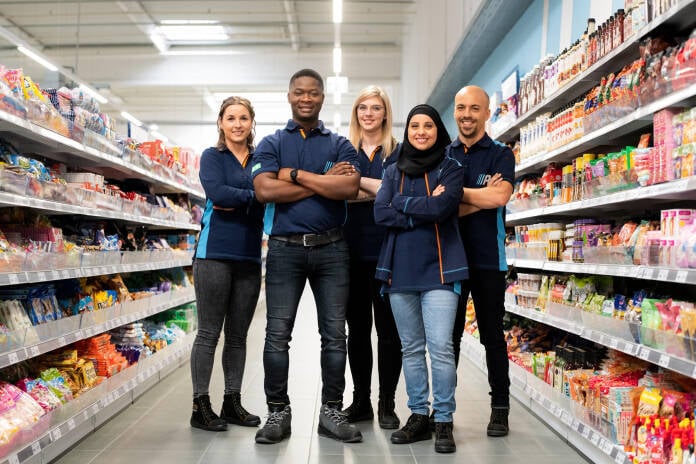
Across our stores, DCs and offices, we employ people from 166 different nationalities, showing the diverse backgrounds in our workforce.
Within Action, colleagues from different backgrounds work closely together and combine their strengths, one of the most important aspects of our distinct culture.
We believe leaders play a crucial role in creating this welcoming environment and helping preserve Action’s culture as the company continues to grow.
Women make up a large part of our workforce, particularly in Action stores. We are encouraging more women to take up positions in senior management. By 2027, we want women to make up at least 40% of Action’s senior management, and we are on course to achieve that target. At the end of 2025, we achieved 39%.
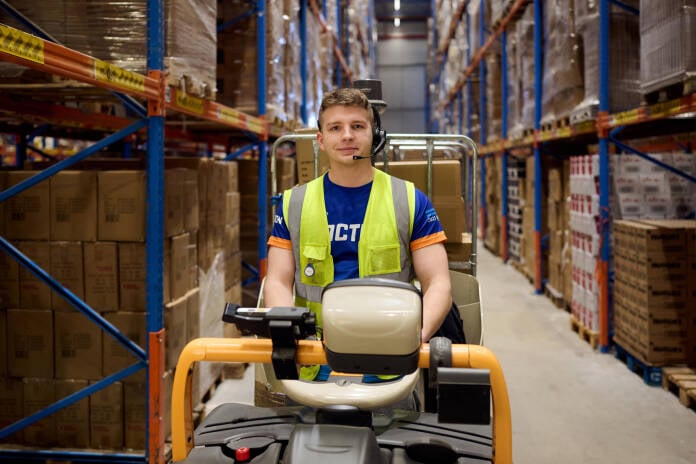
Our distribution centres (DCs) throughout Europe are key to our supply chain and keep Action moving. We invest in leadership and training programmes for our DC colleagues, supporting both their growth and the continuous improvement of these essential operations.
Developing leaders in our supply chain
Training and development
All Action colleagues have access to training so they can reach their full potential. This ranges from developing skills such as how to operate machinery or cash tills to mandatory training in health and safety. We also offer more specialised personal and leadership development programmes.
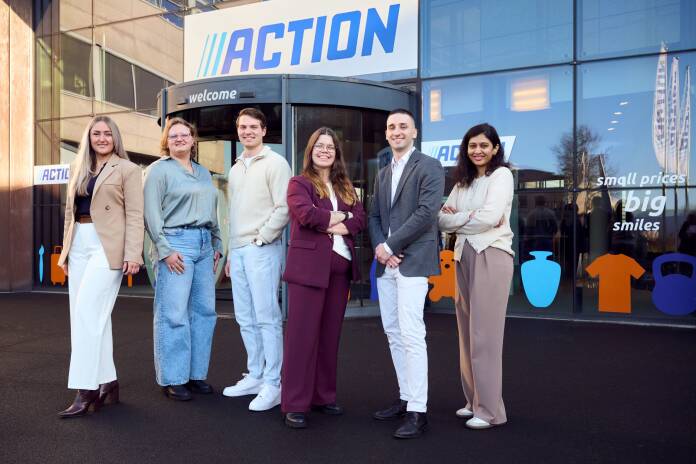
In 2025, we launched our first senior traineeship programme in store operations and finance, and our second junior programme, which offers an 18-month traineeship in commerce, store operations, supply chain management, marketing, finance, real estate or HR. During the year, we also extended our store operations senior traineeship to candidates in countries outside the Netherlands.
We are committed to attracting future leaders and helping our people grow into great leaders themselves.
New traineeships for future managers and leaders
Our commitment to a fair workplace means offering wages and benefits that are competitive and reflect employees’ contributions to Action. Action regularly benchmarks salaries and benefits against those paid by other, comparable employers.
We ensure continued compliance with all national minimum wage legislation, and labour rights and social protection. We have also started work on the EU’s Pay Transparency Directive.
Wages and benefits
In 2025, more than 90% of colleagues completed our latest Voice of Action survey.
Voice of Action
Every two years, we measure employee engagement through our company-wide survey, the Voice of Action. Every colleague gets 30 minutes of paid time and a secure platform to complete the anonymised survey.
This survey helps us to fine-tune our policies and business plans, as our colleagues know better than anyone what they and their teams need to experience Action as a great place to work. This survey also makes clear that we highly value everyone’s well-being, experiences, thoughts and suggestions for improvements.
In 2025, the participation of colleagues in the survey grew for the third year in a row, with a response rate of more than 90%. The response rate and the survey results show our colleagues are engaged and proud to be part of a successful company. They like our entrepreneurial spirit and team culture, the good work-life balance and the clarity of expectations. In general, they feel appreciated and they experience positive relationships with their managers. The survey also identified areas for improvement. All relevant suggestions and feedback will be followed up by our management and translated into detailed action plans to further improve our work environment.
We focus on creating equal opportunities and a supportive workplace where everyone can feel valued and grow. In 2025, this commitment was recognised across Europe with awards in multiple countries.
Employment awards
Speaking up
Workplace health and safety
We want our colleagues to feel safe speaking up about incidents of misconduct. Action colleagues can raise concerns with their manager and HR representative, or through our dedicated Alert Line. This Alert Line allows colleagues to report incidents 24/7 in their own language and anonymously if they prefer.
In 2025, we launched an awareness campaign for the Alert Line, including stepping up communications and providing additional training to managers. We also updated our Speak Up Policy to ensure compliance with EU whistleblower regulations, and extended the Alert Line to customers, contractors and others doing business with Action.
We want to ensure a safe and healthy work environment for everyone in every role, including contractors and visitors.
Our approach to health and safety is based on regular risk assessments across all operations, reinforced by audits and inspections. We are committed to complying with all relevant health and safety regulations. Through our Health and Safety Policy, we commit to minimising risks of injury or accidents.
We provide mandatory health and safety training to all our colleagues and contractors to ensure they understand the risks associated with their tasks and know how to prevent work-related injuries. Those working in DCs receive job-specific training.
Every year, to raise awareness of safety matters, Action organises a Safety Week (covering safety processes) and a Vitality Week (promoting well-being). We also participate in a Security Week (advising colleagues on personal safety).
Building on the
ASP pillar Planet
We are committed to reducing our climate impact and protecting the environment.

1 A small number of stores use externally provided heating (e.g., district heating), and their energy source is unknown.
2 For further information, see www.co2emissiefactoren.nl.
Lowering our greenhouse gas emissions
We are taking steps to reduce greenhouse gas (GHG) emissions from both our own operations and our wider value chain. Our near-term GHG emission targets are validated by the Science Based Targets initiative (SBTi).
Focusing on greenhouse gas emissions caused by our own operations, we are reducing our energy consumption where possible and are switching to renewable electricity in our stores and DCs.
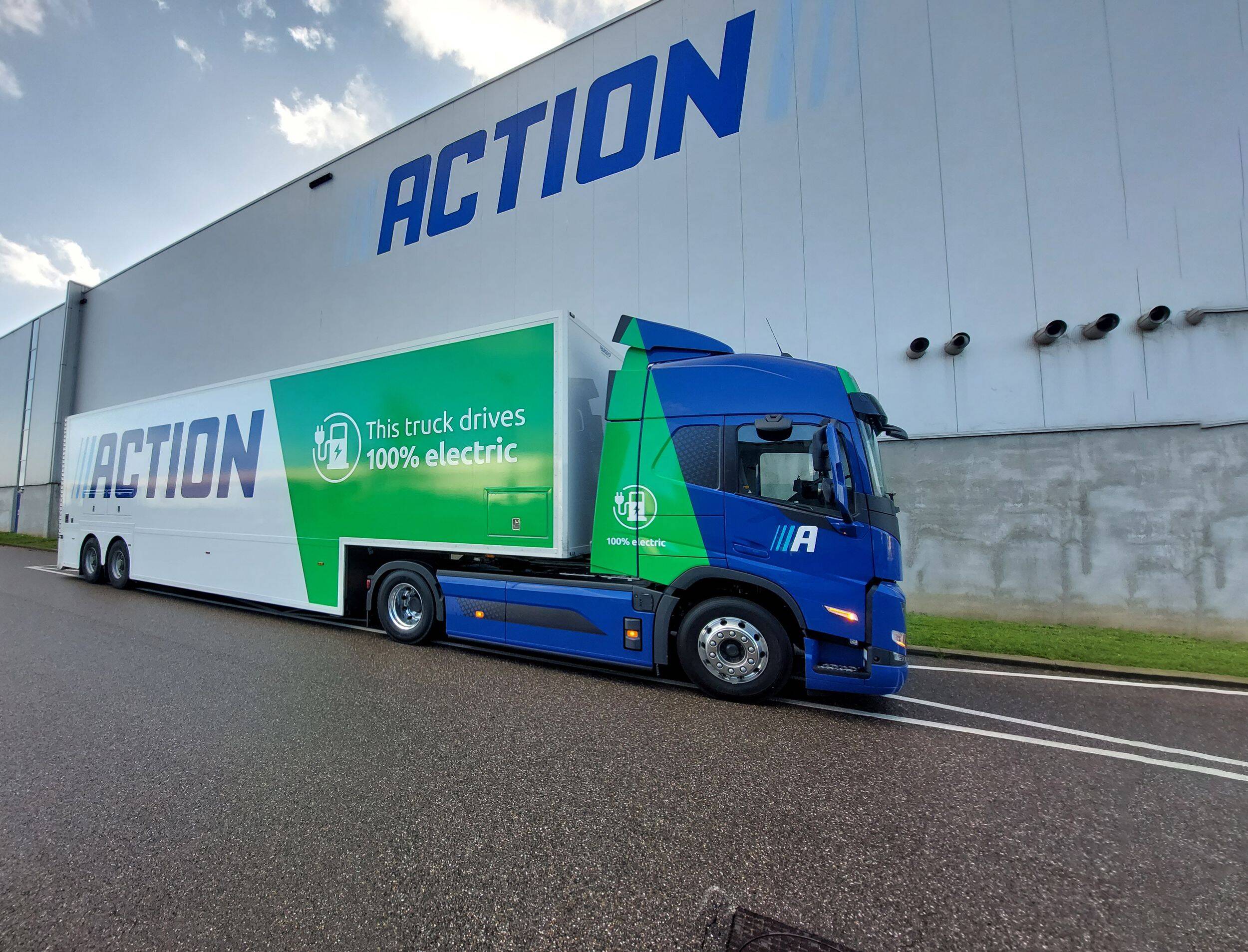
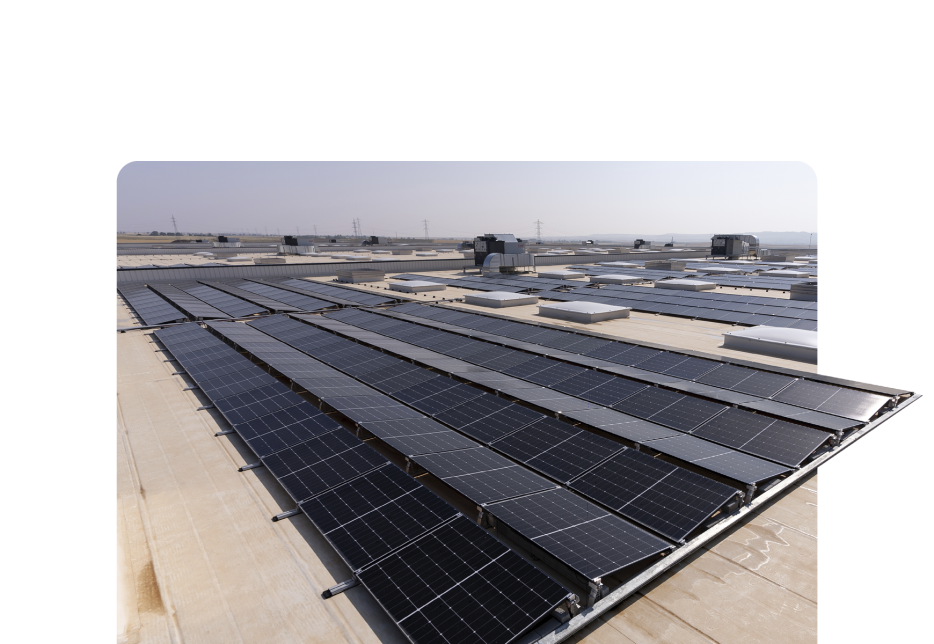
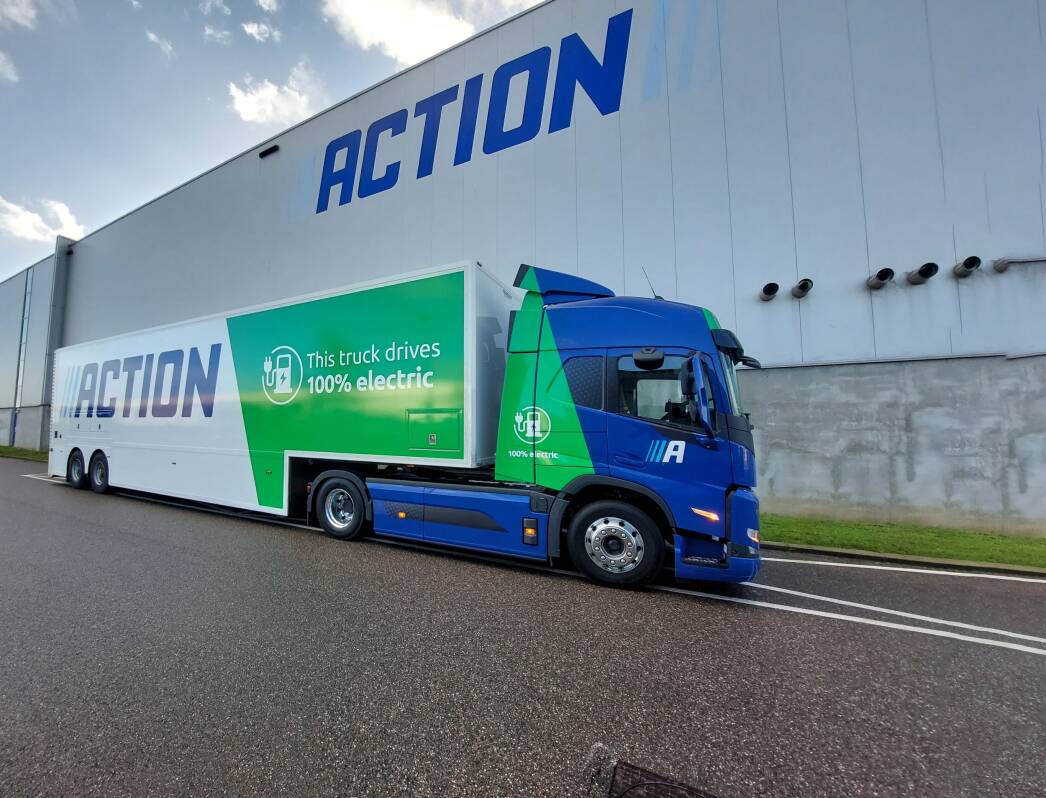
All1 our stores are gas-free. Our new DCs will operate in the same way. Many DCs also have solar panels or space to install them in the near future. We are also working with store landlords to install solar panels where possible. In addition, we have upgraded our fleet of Action trucks in the Netherlands to HVO 100, a renewable diesel that reduces emissions by up to 90% compared with conventional diesel.2 In 2026, we will continue to explore options to make our transport more sustainable.
We are committed to sourcing electricity as sustainably as possible. Renewable sources provided 90% of the electricity we use in our stores and DCs in 2025.
As we move away from gas to heat our stores and DCs, and gradually switch to electric trucks, our electricity consumption is expected to increase. We are therefore also focusing on energy efficiency. Smart meters, sensors and building management systems are helping us optimise our electricity consumption.
In February 2025, Action’s near-term science-based emissions reduction targets were validated by the Science Based Targets initiative (SBTi). That means the targets are in line with the 2015 Paris Agreement’s objective of limiting global warming to 1.5°C. Progress towards our target has been faster than expected. As a result, we were able to raise our reduction target later in the year to 75%, up from the original 60% (from our 2021 baseline).
242
2025
199
2024
Electricity
(million kWh)
26
2025
31
Gas
(million kWh)
2024
1 Categories 3.1, 3.2 and 3.4 are in scope for our supplier engagement target
12.2%
Product use
and disposal
(3.11 and 3.12)
3.1%
Upstream and downstream transport
(3.3, 3.4 and 3.9)
3.9%
Capital goods (3.2)
16.1%
Other emission categories (scope 3)
0.2%
Own operations
(scope 1 and 2)
64.5%
Purchase of
products from suppliers (3.1)
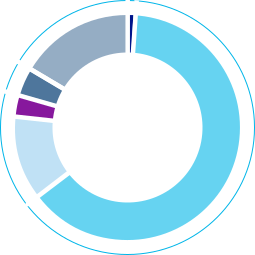
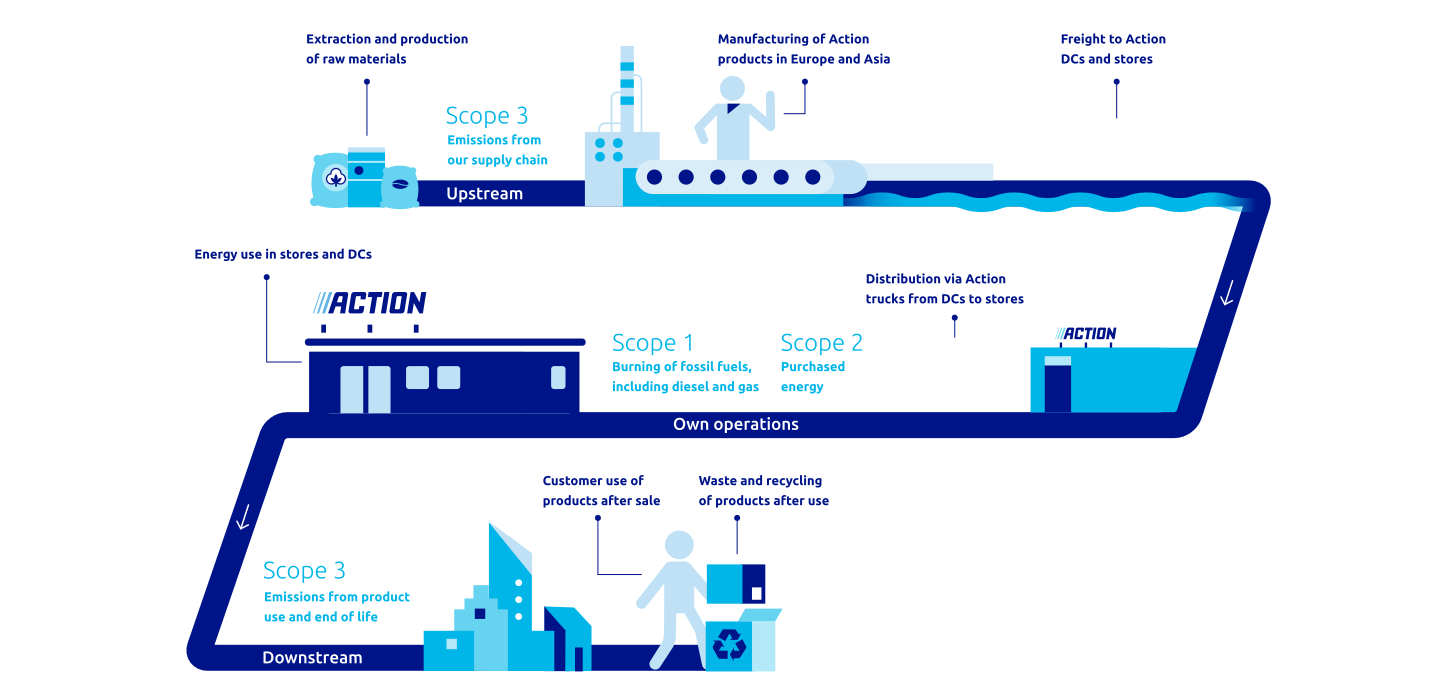
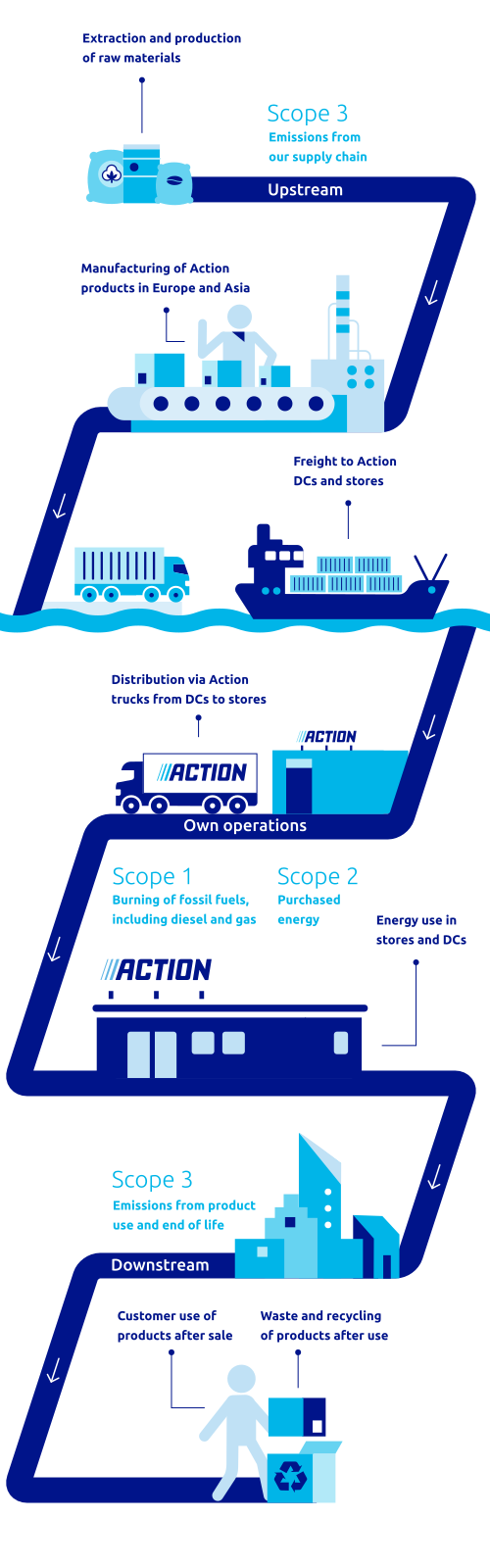
Scopes 1 and 2 refer to greenhouse gas emissions from our own operations, such as energy consumption in our stores, distribution centres and offices, and fuel for our trucks. Scope 3 refers to emissions from our wider value chain, including the manufacturing and transport of products (upstream), as well as their use and disposal (downstream). For formal definitions, please refer to the Greenhouse Gas Protocol.
Over the past five years, we have reduced greenhouse gas emissions from our own operations by 56%, mainly thanks to increased energy efficiency and a switch to renewable sources.
Cooperating with our supply chain
Even as we continue these efforts regarding our own operations, we recognise that almost all of Action’s GHG emissions originate from our wider value chain. As we have grown in recent years, so have these GHG emissions. These indirect, so-called scope 3 emissions occur during manufacturing, in the transportation of our products, and through customer use and waste disposal.
In 2025, we began working with our suppliers on climate action. As a first step, we are engaging with our suppliers to set science-based targets. At the end of 2025, 15% of Action’s suppliers in scope (as measured by emissions) had validated near-term science-based emissions targets in place. Our objective is that by 2029, suppliers representing 80% of our scope 3 emissions1 will have set science-based targets. To achieve this, we will be working closely with suppliers, providing guidance and support where possible.
We are already partnering with our ocean carriers to reduce the environmental impact of shipping products from suppliers in Asia to Action DCs in Europe. Since 2023, we have been sourcing certified biofuels for some of the fuel our ocean shipments consume. These biofuels offer a renewable, low-carbon alternative to fossil fuels, reducing our greenhouse gas emissions. In 2025, 50% of our containers for direct sourcing were shipped with biofuels, bringing the total emissions saved (compared with standard fossil fuels) to 50,161 tonnes of CO2 equivalent in 2025.


Greenhouse gas emissions across Action’s value chain

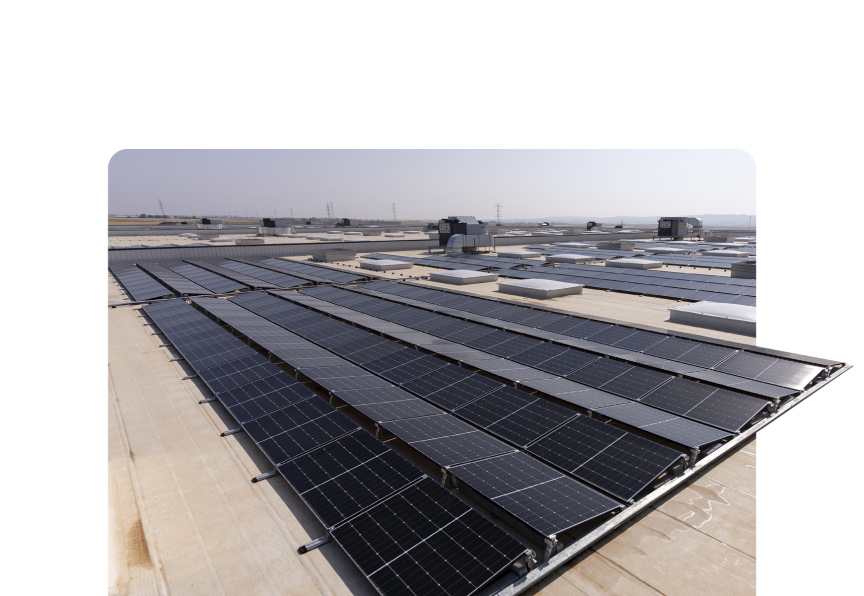
Action marked the official opening of its first gas-free DC at Illescas in central Spain in June 2025. Illescas has been certified ‘Outstanding’ by BREEAM, one of the most widely recognised environmental standards for buildings.
A new generation of Action distribution centres
Managing climate risks
Protecting nature
Climate change could affect our business directly. One of the biggest risks is extreme weather like storms and floods. These could disrupt deliveries of our products, or force DCs to close.
Our business model helps us manage these risks. Only one-third of our product range is fixed. That allows us to switch to other products when necessary, if supplies are disrupted. Sourcing from a variety of suppliers also makes our operations more resilient to the possible effects of climate change.
In addition, our distribution network has the capacity and operational flexibility to continue to supply stores should one or more DCs be forced to close. We also make sure that climate resilience is built into the design of all our DCs.
Biodiversity is important to our business. Action relies on the natural world to provide materials for our products, as well as for maintaining healthy ecosystems and resilient supply chains.
We already have initiatives that help protect biodiversity and conserve natural resources. These include our policies on responsible sourcing, as well as our efforts to reduce emissions and waste and to promote the use of recycled materials.
Biodiversity is a highly complex topic that requires time and attention to formulate an effective strategy, recognising the significant challenges involved. In 2025, we commissioned our first detailed biodiversity impact and dependency assessment. In the coming years, we will use the results to further integrate biodiversity into our Action Sustainability Programme.
Building on the
ASP pillar Product
In 2025, we made significant progress within the Product pillar of the ASP. This covers the quality, safety and sustainability of our products and packaging, as well as labour and human rights in our supply chain.
Constantly improving
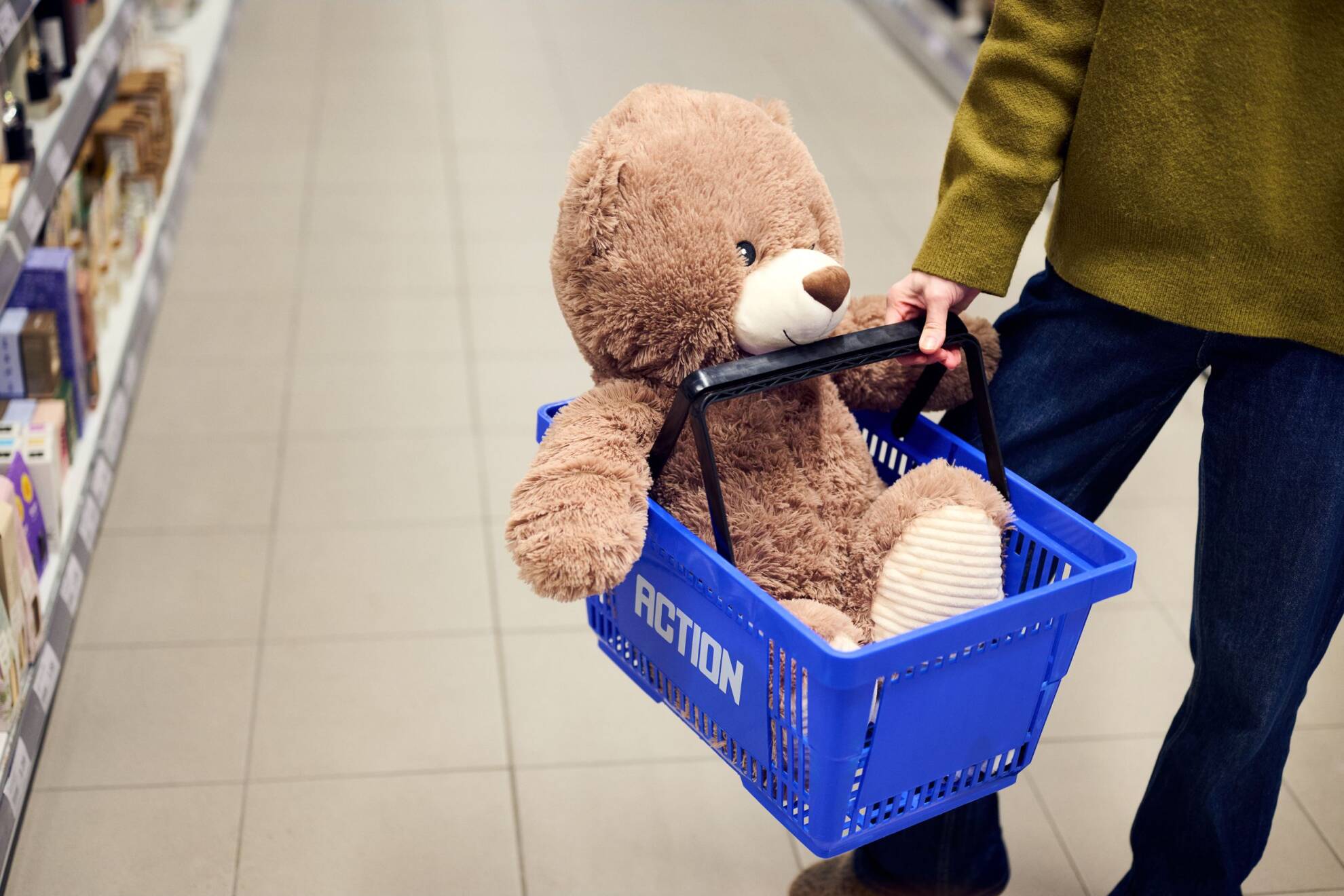
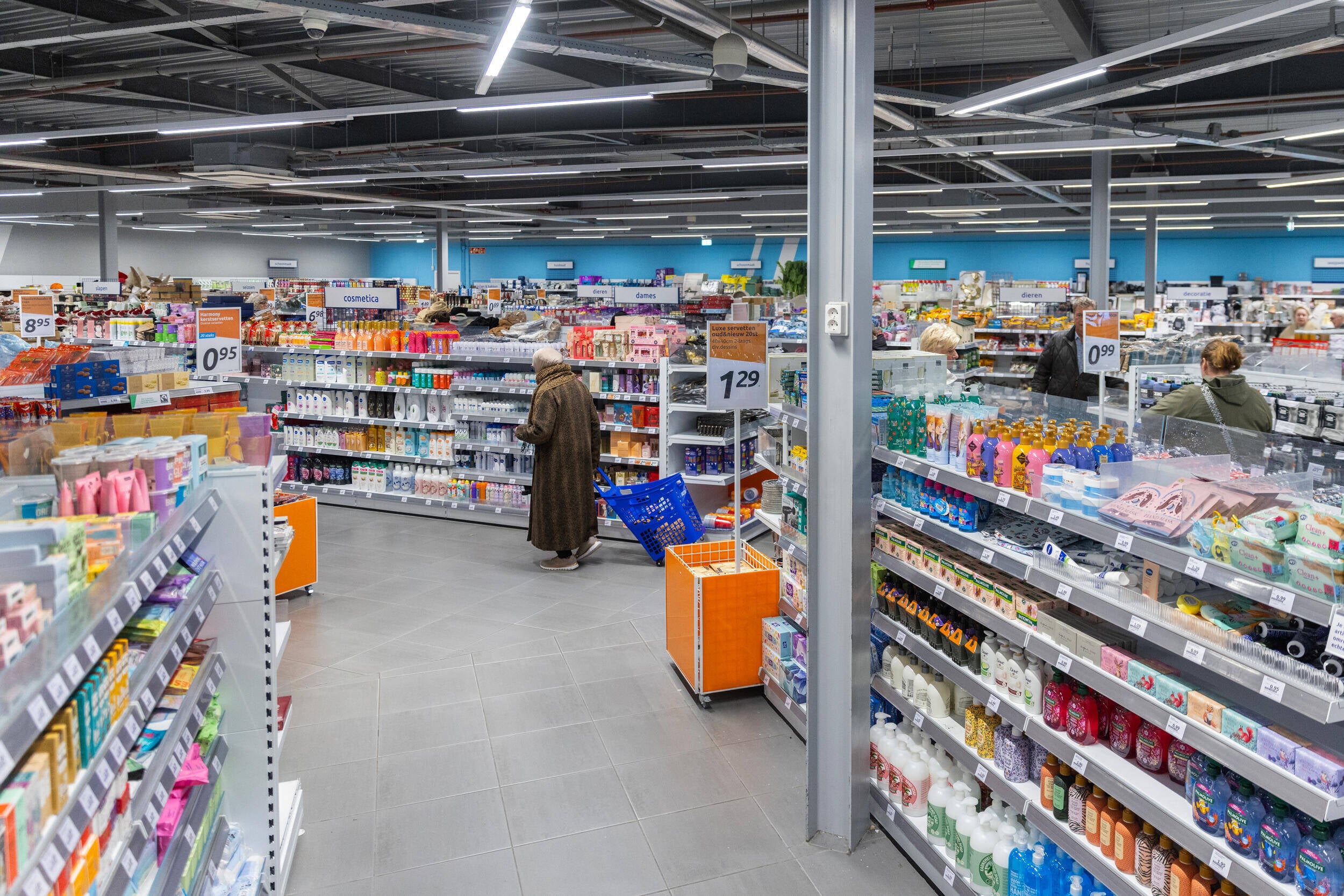
While we offer the lowest prices to our customers, we are also constantly looking for ways to improve our products by making them more durable, easier to repair or recycle, and their packaging more sustainable.
A solid quality process
Our first priority is to ensure all Action products are of good quality. We have dedicated quality and safety teams working across our business, supported by a system of strict quality tests, inspections and controls. This work begins as soon as we identify a product we would like to sell.
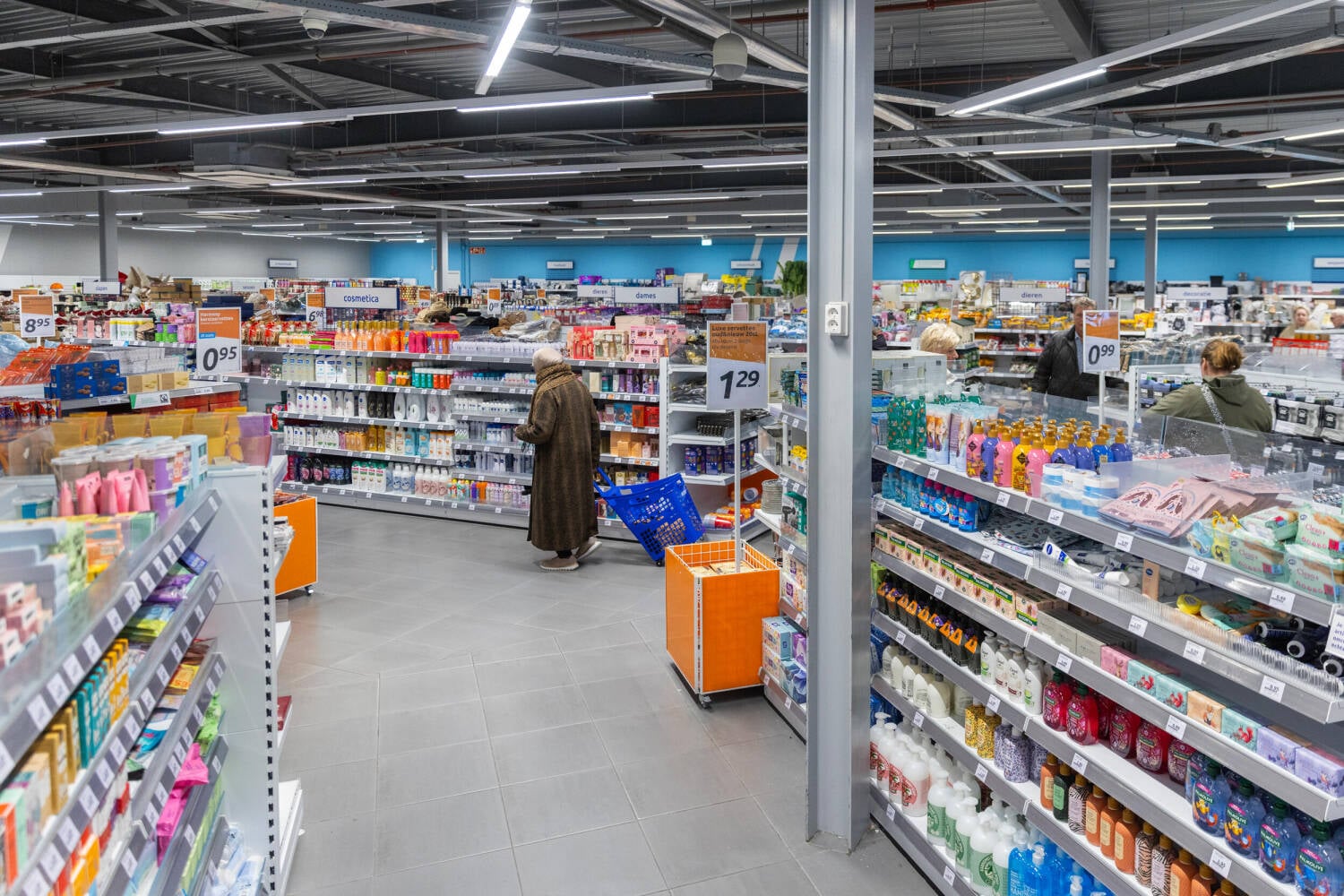
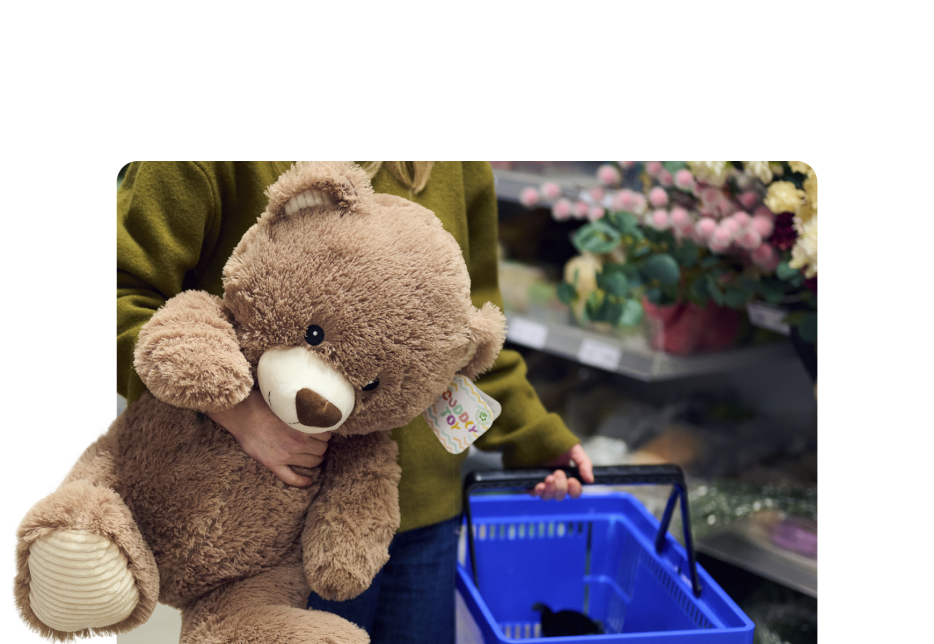
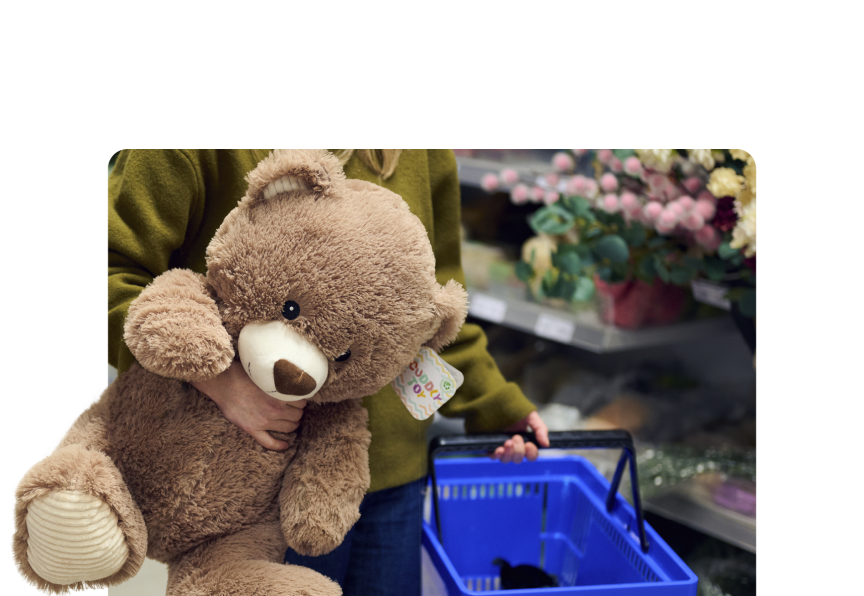
Action conducts regular checks to make sure all products meet rigorous safety and quality standards. There are some products where closer scrutiny and controls are necessary. These include toys for young children under the age of three.
Testing teddy bears
Recalls
At all times, the safety of our customers and colleagues is our top priority. If, despite our best efforts, we find that products pose a risk to customers, or fail to meet requirements, they may be withdrawn.
When a product is withdrawn, we inform authorities and the public immediately. We also instruct customers on how to recognise the product and how to return it or dispose of it safely.
We make a distinction between silent withdrawals, resulting from a technical deficiency such as an incorrect label, and public safety withdrawals, where there may be a risk to the health and safety of customers. In 2025, we recorded 9 public safety withdrawals.
We apply the same strict quality and safety standards to all our products, regardless of their origin.
All suppliers must adhere to Action’s Product Safety Policy. This means ensuring that:
all products are fit for purpose and comply with the relevant regulations;
the same safety and quality standards are also applied to their suppliers and contractors;
they document all quality assurance processes, train their employees and keep proper records.
For most suppliers, we carry out on-site audits. In-line inspections are conducted before, during and after production. All containers are inspected when leaving a factory, and once again when products reach Action DCs. We also have products tested at internationally recognised laboratories.
Every product, whether sourced directly from factories or via wholesalers and importers, undergoes rigorous testing and documentation aligned with Action’s internal standards as well as EU safety regulations.
All private label and directly sourced products have a technical file. This contains all required test reports, safety data sheets and declarations of conformity.
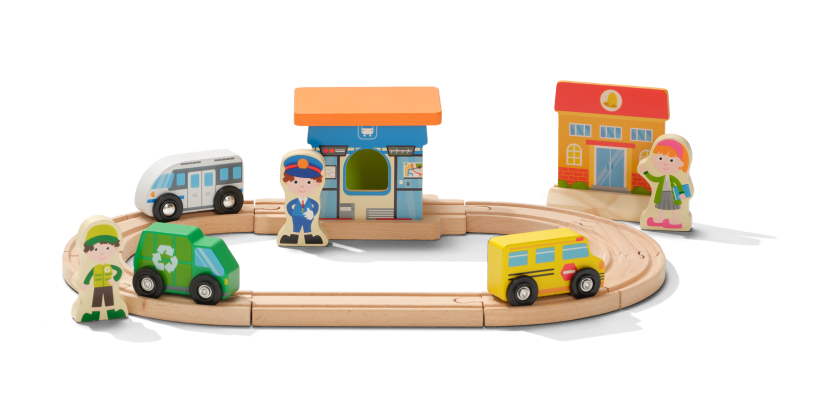
For specific categories, we carry out additional testing. Electrical products, for example, must meet the GS-Mark safety standard, while toys undergo more frequent testing to ensure they are safe for children (see opposite).
Sustainable sourcing
Many of our products are made using natural materials. We have a responsibility to use these resources in a sustainable way. More than 99% of all cotton, cocoa, timber, coffee and palm oil used in Action’s private and white label products is certified sustainable.
In most instances, these certifications are printed on product labels or packaging, allowing our customers to instantly recognise that the materials have been sustainably sourced.
By working with independent and recognised certifiers like the Better Cotton Initiative and the Roundtable on Sustainable Palm Oil, customers can be confident that our cotton is produced without using hazardous pesticides, for example, and that our palm oil comes from plantations that protect the world’s forests and other vital ecosystems.
These certifications apply to more than 99% of Action’s private and white label products in scope based on type, volume sold or weight.

Palm oil
Our Zenova sun care products, including sunscreen, aftersun, sun lotion and sun milk, are either made with 100% RSPO-certified palm oil (and derivatives) or do not contain palm oil at all.
Coffee
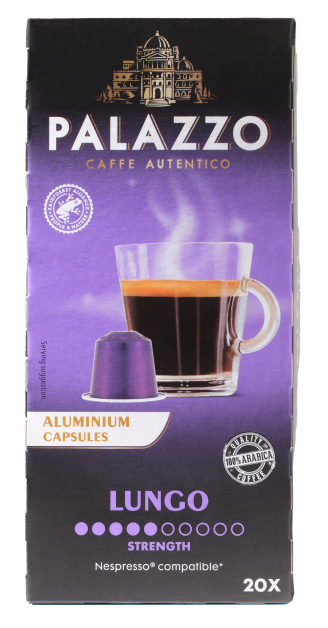
Coffee sold by Action is certified as sustainable by Rainforest Alliance (RFA).
Timber
Timber used in our products comes from sustainably managed forests, certified by the Forest Stewardship Council® (FSC®) or the Programme for the Endorsement of Forest Certification (PEFC).

Cocoa
Cocoa used in Action products is certified as sustainable by Fairtrade International, or by other recognised standards.
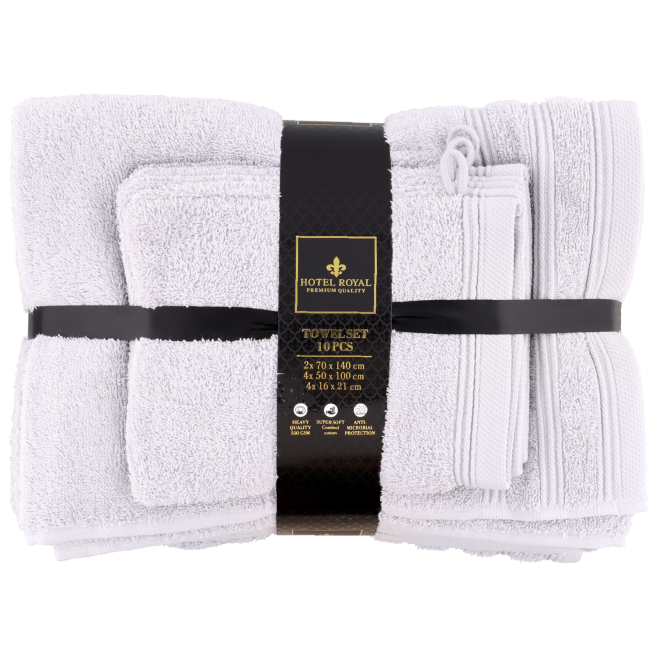
Cotton
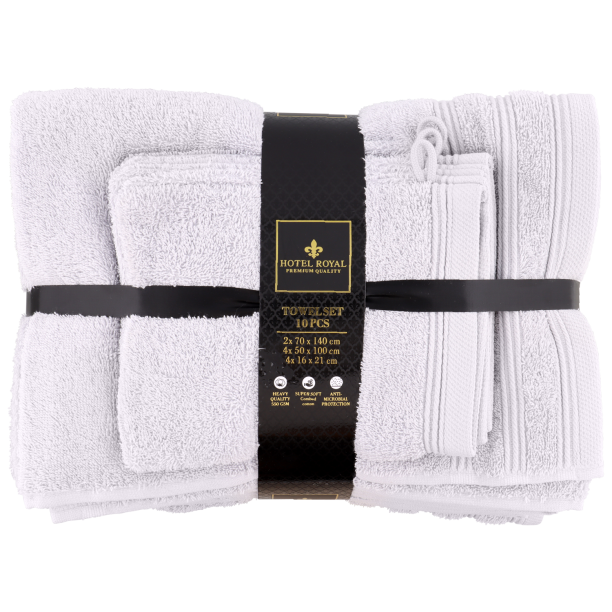
Cotton used in our products is sustainably sourced under the Better Cotton programme, organic or recycled. A key example is our own Hotel Royal towel range, which is made from 100% cotton or blends with cotton satin or jersey. All materials are more responsibly sourced through Better Cotton.
We are always looking for opportunities to make our products more sustainable. This means working hand in hand with our suppliers, product by product.
A blender built to last

Circularity and continuous improvement
We are constantly looking for opportunities to make our products longer lasting, or easier to repair and recycle. To make these improvements, we listen closely to customers and suppliers to understand their experience with products. Whatever improvements we make, we always maintain our lowest price promise.
Making our products more durable, easier to repair or recycle also means we can use resources more efficiently, reduce our reliance on non-renewable materials and keep waste to a minimum.
We want to increase the circularity of all product categories, paying particular attention to products that consume the most resources. With this approach, we have made significant progress in recent years, especially in our linen, household goods and garden & outdoor ranges. We increasingly communicate about these product improvements and provide our customers with insights into the sustainable characteristics of our products.
Making improvements to our products requires close collaboration with our suppliers. In 2025, we launched a new supplier outreach programme to help improve overall product circularity.
We recognise that plastics play a vital role in society. Action uses plastics in a range of products, from household goods to multimedia and decorations. However, we are aware that plastics may cause environmental damage if not recycled or processed properly.
For that reason, we are committed to using plastics responsibly. By year-end 2025, our plastic products in scope contained 37% recycled material, ahead of our target of 35% by 2025. From 2026, all the recycled plastic we use in Action’s private and directly sourced import products will be independently certified under the Global Recycled Standard or Recycled Claim Standard labels.
Recycled and circular products
Action sells products made entirely from recycled materials, for example, our Action shopper bag, Spectrum floor cover and Studio Home flannel throw. We are also turning our waste into new, circular products. Our waste management programmes are based on effective separation, collection and recycling. Cardboard and plastic are compressed at our DCs and then sent to recycling facilities. We use these materials for 100% circular products, like the bin bags and bins we introduced in 2025.
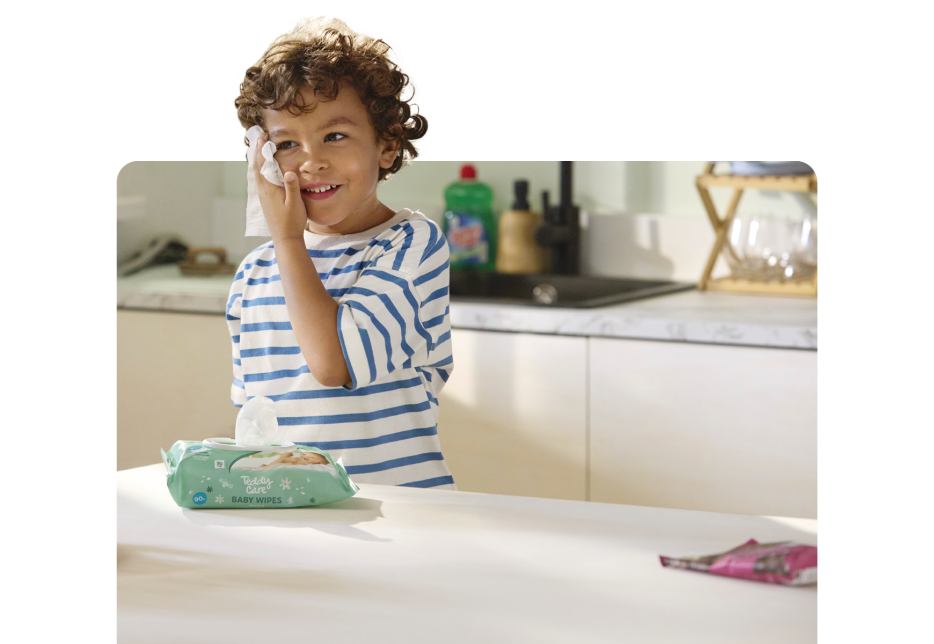
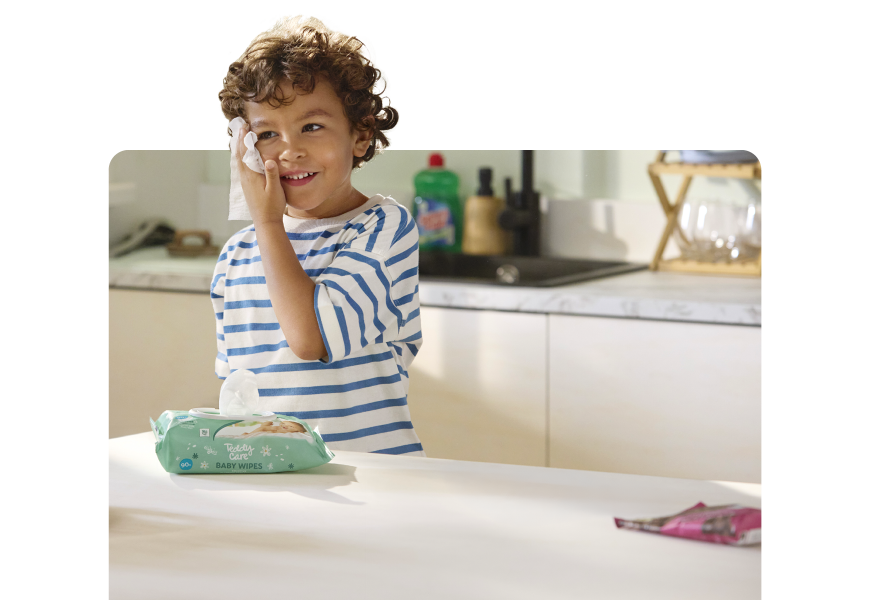
Microplastics are widely used in personal care products, but they can cause harm to the environment. Action is eliminating microplastics where possible.
Caring for babies, caring for the planet
Sustainable packaging
29%
From 2019 to 2025, we reduced the amount of packaging (by weight) used in our fixed range products by 29%.
Moving to sustainable packaging is an important part of our efforts to minimise our impact on the environment. We are committed to reducing packaging waste by decreasing both the amount and weight of our packaging.
We have eliminated all non-recyclable packaging and are replacing plastic where possible with more sustainable materials, such as fibre-based materials or FSC or PEFC-certified paper and cardboard.
In 2025, we also phased out the use of hard-to-recycle PVC and black plastics in our packaging, and we are working with suppliers to ensure compliance with the EU’s future packaging regulation.
All Action’s primary packaging (the packaging in direct contact with the product) is now fully recyclable, and all cardboard used in the packaging of Action’s private and white label products is certified sustainable.
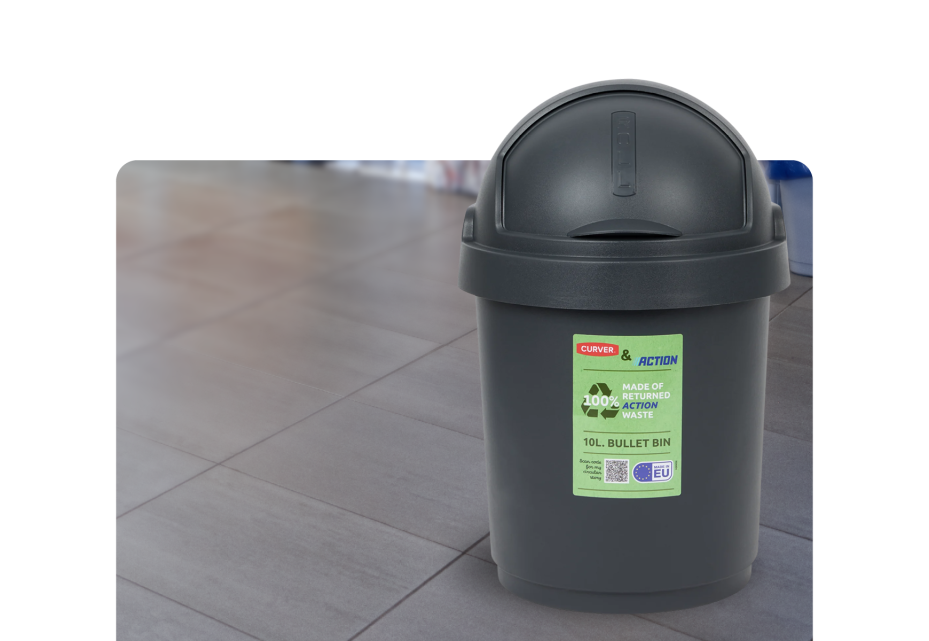
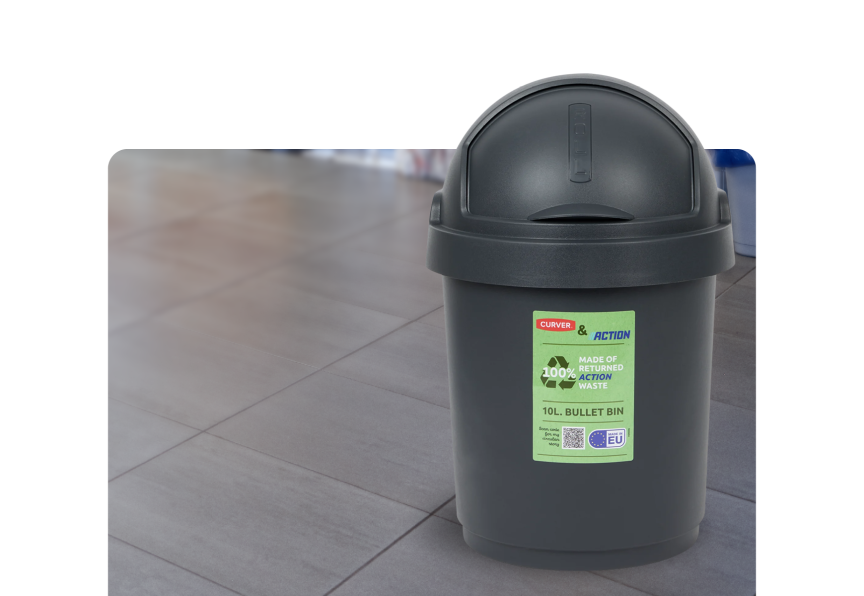
In 2025, a new Curver refuse bin went on sale in our stores. The bin is made from plastic collected at our DCs.
Making a refuse bin from recycled waste
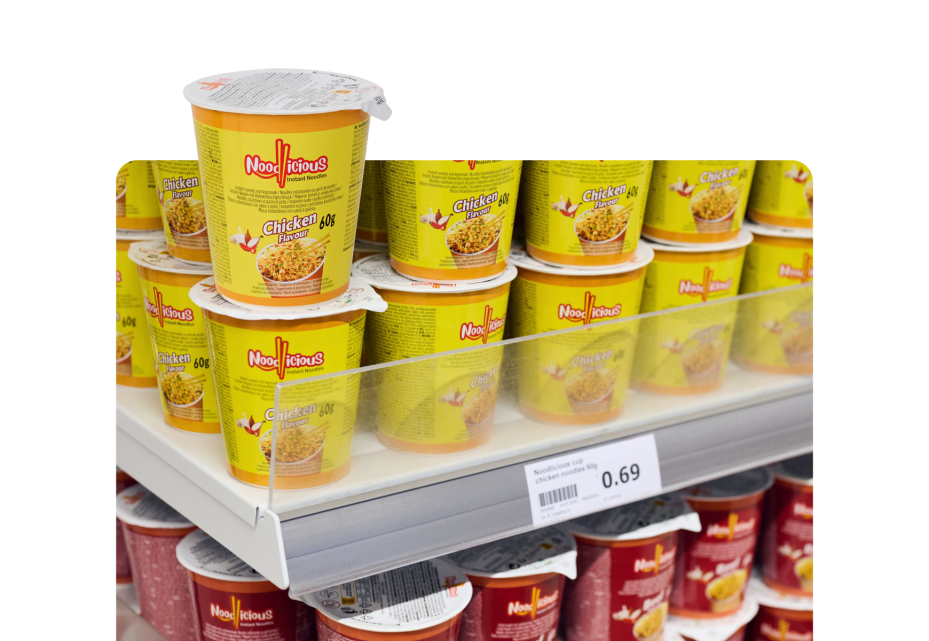
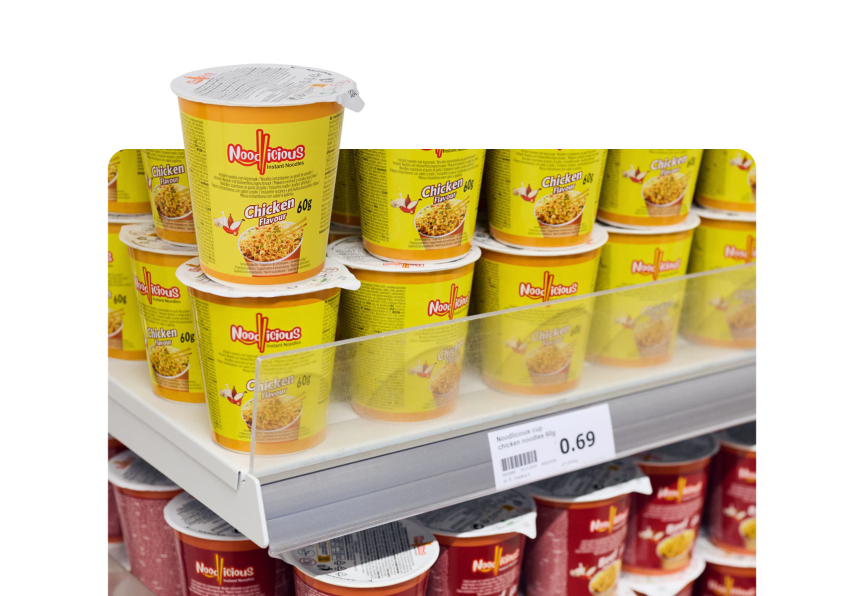
To help protect the environment, we are reducing our use of non-renewable materials, which often end up as waste. One example is our Noodlicious instant noodles
From plastic to paper for Noodlicious instant noodles
Action is expanding its range of products for pets and making more use of sustainable materials at the same time.
A plush bed for pets with 100% recycled filling

96%
3 Risk countries are defined by the amfori BSCI Country Risk Classification
In 2025, we carried out 2,739 assessments, including both social audits and spot checks. That is over 96% of the factories we work with in risk countries.3 Our goal is to increase this figure to
100% in 2026.
Labour and human rights in our supply chain
Thousands of people around the world make products for Action. It is our responsibility, along with our suppliers, to make sure they have decent working conditions. We buy only from suppliers who respect human and labour rights.
We apply the same strict standards to all suppliers, from the smallest garment factory to the largest toy manufacturer, regardless of how long they have been working with us.
Standards for suppliers are set out in Action’s Ethical Sourcing Policy. This policy is based on UN principles and international labour standards. We require our suppliers to comply with these standards and we expect them to share the standards with their own suppliers and business partners. In this way, we help protect the rights of workers in the wider industry.
Our Ethical Sourcing Policy includes zero tolerance for child and forced labour, among other things, as well as provisions for health and safety, non-discrimination, and fair pay.
When sourcing from countries with an elevated risk of human rights violations, we align ourselves to UN and key NGO partners' recommendations and governance, and comply with applicable economic sanctions and trade restriction laws and regulations.
We regularly assess our suppliers to ensure compliance with our standards. In risk countries, we take additional measures, including social audits and spot checks in factories, to make sure workers’ rights are respected.
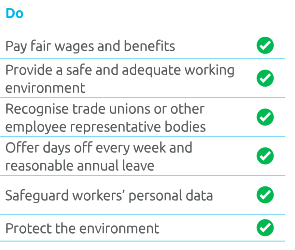
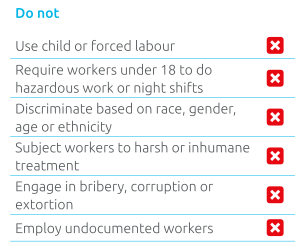

Some suppliers use homeworkers to help make products such as handmade decorative items.
Protection for homeworkers
Value chain transparency
To help protect the rights of workers, we need to know where our products are made and by whom. Our supply chain involves a significant number of wholesalers, factory workers, farmers, producers, agents and importers. By the end of 2025, we had mapped 97% of factories handling the final stage of production, a total of more than 3,900 factories worldwide. In 2026, we plan to further extend this transparency to factories involved in earlier stages of production. Our aim is to achieve full value chain transparency for private and white label products by 2030 at the latest.
Throughout this process, we work with our suppliers, providing training and advice, so they can make necessary improvements. As a last resort, we may exclude suppliers or delist products if we believe the risks to workers are too great. If a factory fails an audit, we do not place new orders until we can be sure the problem has been resolved.
In addition to our Ethical Sourcing Policy, we have a complementary Child Labour Policy and a Critical Escalation Policy, which sets out how we handle critical breaches of our standards. Our responsible sourcing policies on cocoa, cotton, palm oil and timber also require suppliers to protect internationally recognised human and labour rights.
We are developing new detailed policies on the use of forced labour, homeworking and protecting health and safety in factories and other sites, to ensure suppliers know exactly how to operate in line with our ethical sourcing standards.
Fair pay is a core part of Action’s Ethical Sourcing Policy. We respect minimum wage legislation, and we expect our suppliers to do the same.
Handling a critical incident in Pakistan
Critical human and labour rights cases
From time to time, we may receive reports of critical incidents related to human and labour rights. These incidents relate to serious breaches of our standards, for example, incidents of bribery, inhumane treatment, child labour or severe health and safety issues.
We investigate all reported incidents. As soon as an incident is substantiated, we suspend all shipments from the supplier and set about fixing the problem. We do this in close cooperation with the supplier. Action may disengage if a supplier fails to cooperate or further critical cases are reported, depending on their severity. In cases of child labour, we work closely with experts from the Centre for Child Rights and Business. In 2025, we registered 14 critical labour rights incidents. Most of these related to health and safety violations. The incidents are in scope for disclosure based on the results of our double materiality assessment (see the PDF version of our report for details on our material topics).
It is important to us that people working in our supply chain have a voice. Misconduct or violations of our standards can be reported anonymously and without fear of retaliation through our Speak for Change or FaceUp platforms. Our own Alert Line is also open to workers at direct sourcing suppliers and wholesalers to report incidents on Action premises.
Building on the ASP pillar Partnership
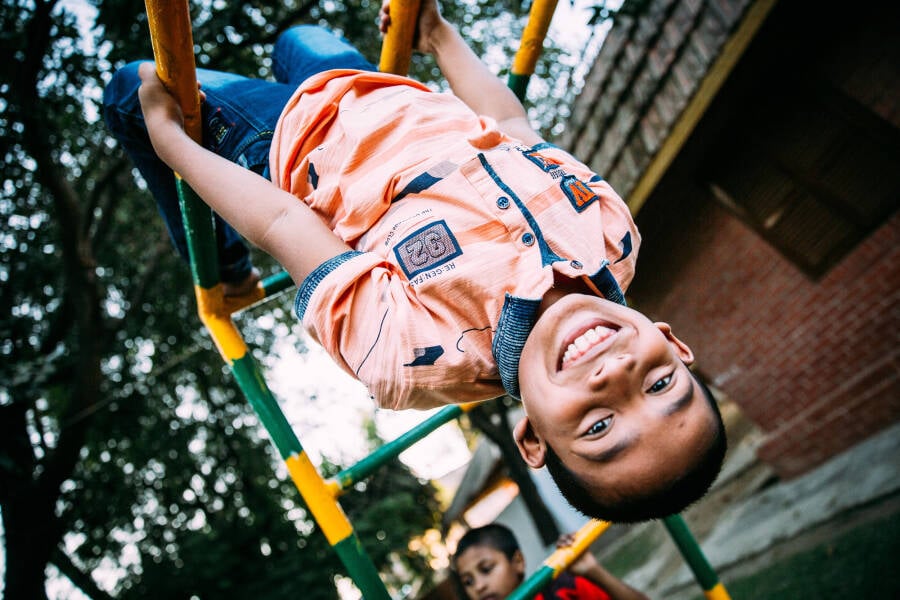
Action wants to contribute to the communities where we operate. We focus on children, as they are the future and we believe children deserve a safe and healthy start in life. Over the years, we have worked closely with our partners SOS Children’s Villages and the Johan Cruyff Foundation.
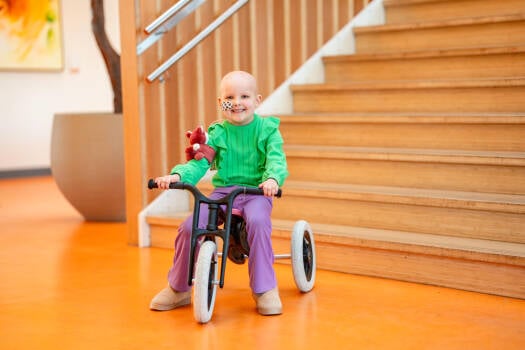
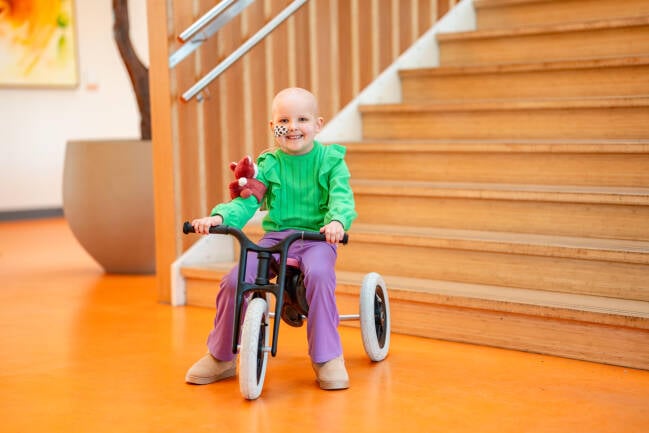
In 2025, we added a new partnership with the Princess Máxima Foundation, which specialises in research and treatment of childhood cancers.

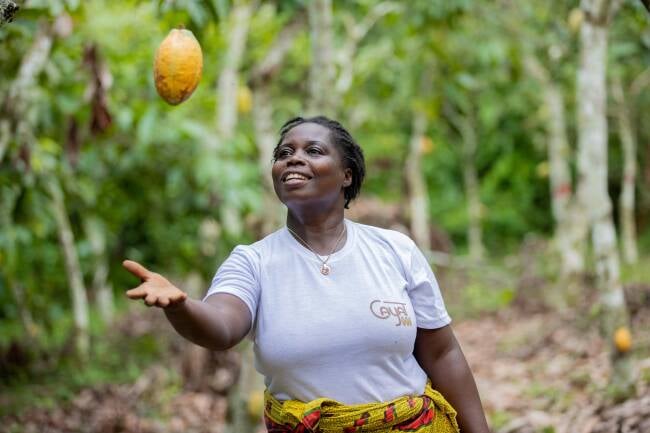
Fairtrade Living Income
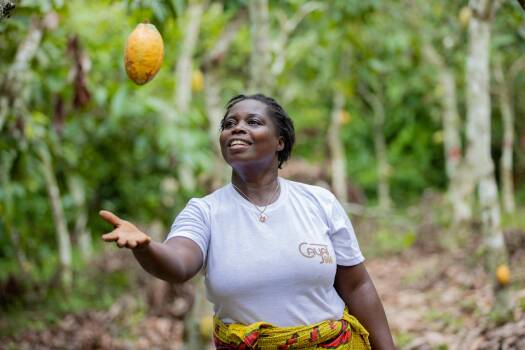
Under our partnership with Fairtrade, all private label chocolate sold at Action is Fairtrade certified, and since 2022 we have paid an additional premium for the cocoa used in our private label products.
In 2025, Action became the first international retailer to commit to a special Fairtrade Living Income Cocoa Fund. The fund supports three cocoa cooperatives in Ivory Coast, helping farmers move towards earning a living income. The fund can be used for improving farming techniques or providing education opportunities for local children, supporting more sustainable livelihoods in cocoa-growing communities.
Johan Cruyff Foundation
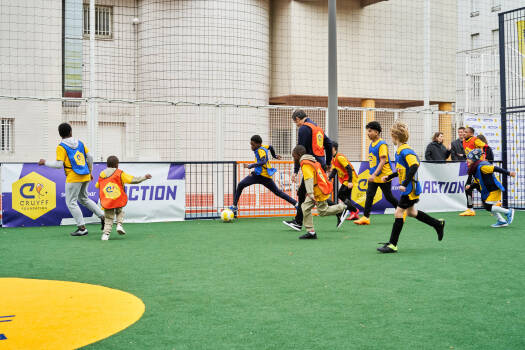
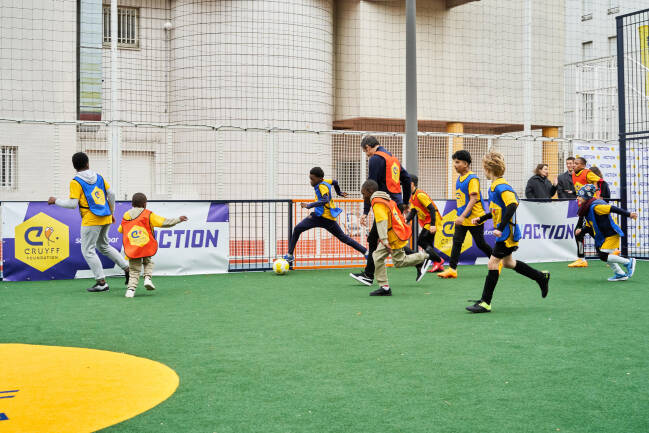
Through our partnership with the Johan Cruyff Foundation, we support sports and play opportunities for children. The Foundation creates safe, accessible spaces where children and young people can play, exercise and develop through sport.
The first Action-supported Cruyff Court opened in Paris in 2025. In the coming years, more Cruyff Courts will be built near Action stores in countries including the Netherlands, France, Germany, Spain and Belgium, helping support local communities and encouraging an active lifestyle among children.
Princess Máxima Center Foundation
Based in the Netherlands, the Princess Máxima Center Foundation has a global reach through a network of partners specialising in childhood cancer research, diagnostics and treatment. Through this new partnership, Action will support the Foundation’s core mission: to cure every child with cancer.
This partnership will formally launch across the countries where Action operates from 2026.
SOS Children’s Villages
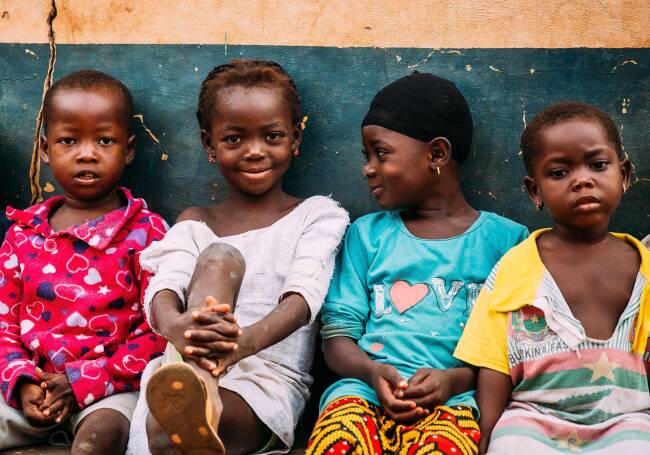
We have been working with SOS Children’s Villages since 2018, providing care for children and young people, often those without or at risk of losing family support. Our support is directly linked to the number of Action stores and distribution centres, meaning that as Action grows, so does our contribution.
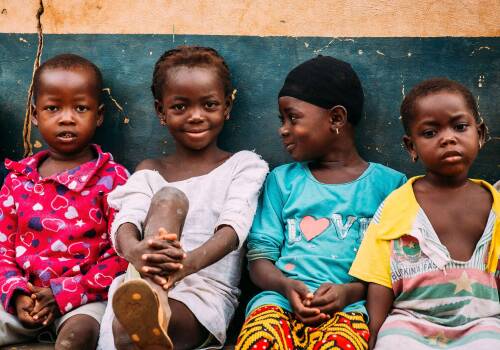
Historically, our support has mainly focused on Asia, where Action has a strong supplier base. In 2025, we began extending our partnership into Europe, bringing our support closer to the communities where we operate our stores. Through this partnership, Action supported 17,491 children in 2025.


Action is committed to acting responsibly, with respect for people and the environment, and to making sustainability accessible every day for our millions of customers. Working at such a scale with our many suppliers and business partners means we can collaborate on sustainable improvements to products, packaging and processes.
Our ambitions are set out in the Action Sustainability Programme (ASP). Inspired by the UN’s 2030 Sustainable Development Goals and the European Green Deal, this ongoing programme is based on four pillars: People, Planet, Product and Partnership, each with its own clear goals and priorities.
We are closely connected to the communities in which we work and contribute to their wellbeing where possible. We focus on helping children because we believe all children have the right to grow up in a safe and loving environment.


We continually invest in the quality and sustainability of our products and in making our value chain more transparent to uphold our ethical sourcing standards, buying only from suppliers who respect human and labour rights.
We are committed to reducing greenhouse gas (GHG) emissions across our value chain. Our near-term science-based emissions targets are validated by the Science Based Targets initiative and in line with the Paris Agreement’s objective of limiting global warming to 1.5°C.
Our colleagues are the beating heart of Action. We offer stable employment to a fast-growing number of people. We support our colleagues by providing teamwork, and growth and learning opportunities, so we can reach our potential regardless of our backgrounds.
From just one store in 1993, we have grown to more than 3,300 stores by the end of 2025, mainly thanks to the hard work, skills and commitment of our colleagues. Every day, these colleagues contribute to a work environment based on teamwork and respect, where everyone is welcome, regardless of their background.
Building on the
ASP pillar People
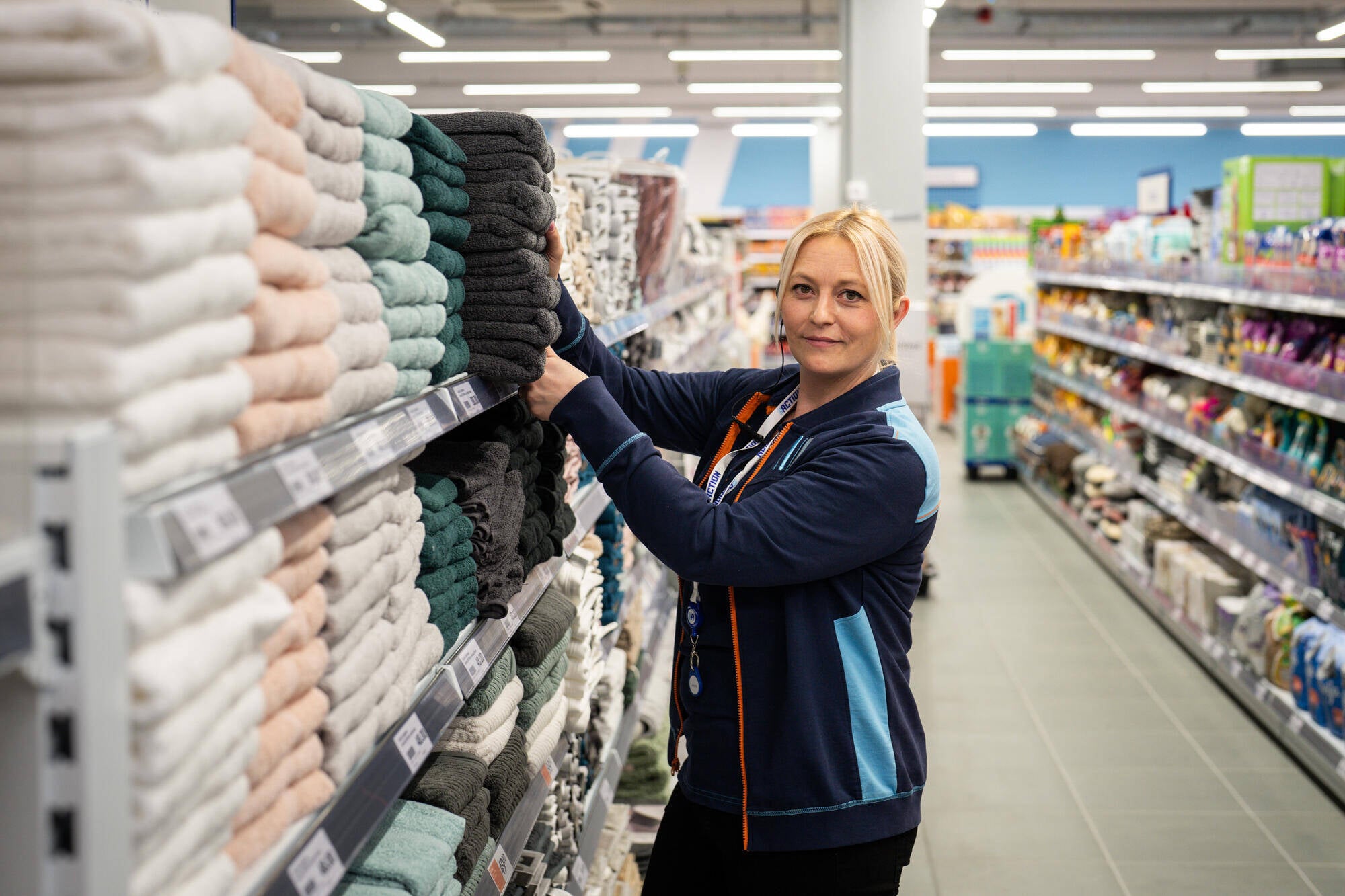
During 2025, Action colleagues spent an average of 4.2 hours in training and development, achieving our target for the year.
Our workforce reflects the communities we serve. We are committed to providing access to training, career development and giving the support our colleagues need to perform and succeed through simplified and strengthened HR processes. Through our flexibility with personal responsibilities and providing equal opportunities as part of our everyday business, we strengthen our team and help colleagues to grow.
We invest in training and development and promote from within Action. Over the past year, we promoted 3,705 colleagues to more senior roles and achieved our target of at least one promotion per Action store. We also provide traineeship programmes for aspiring store operations managers and those looking for careers in areas such as finance, marketing and real estate management.
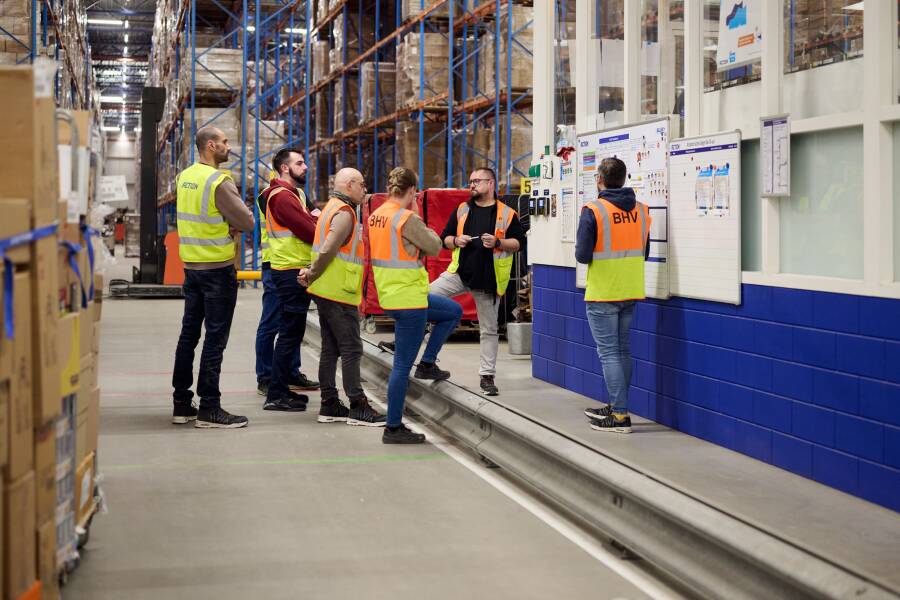
Within Action, colleagues from different backgrounds work closely together and combine their strengths, one of the most important aspects of our distinct culture.
We believe leaders play a crucial role in creating this welcoming environment and helping preserve Action’s culture as the company continues to grow.
Women make up a large part of our workforce, particularly in Action stores. We are encouraging more women to take up positions in senior management. By 2027, we want women to make up at least 40% of Action’s senior management, and we are on course to achieve that target. At the end of 2025, we achieved 39%.
Welcoming work environment
Across our stores, DCs and offices, we employ people from 166 different nationalities, showing the diverse backgrounds in our workforce.
Sandra, one of our Assistant Store Managers in France, joined Action in 2019 while caring for her elderly mother and her disabled daughter. From the start, Action created a contract to fit her needs, offering a schedule so she could balance work and family responsibilities. As her situation changed, we supported her ambition by increasing her hours from 24 to 30, then 35, eventually promoting her to Assistant Store Manager. By listening to our people and finding solutions that work for them, we help colleagues thrive and build careers they value. Sandra’s journey shows that at Action, personal challenges do not have to stand in the way of professional growth.
Figures relate to women employed at Action’s international headquarters, DCs and country offices.
39%
2025
37%
2024
35%
2023
34%
2022
We are committed to attracting future leaders and helping our people grow into great leaders themselves.
New traineeships for future managers and leaders
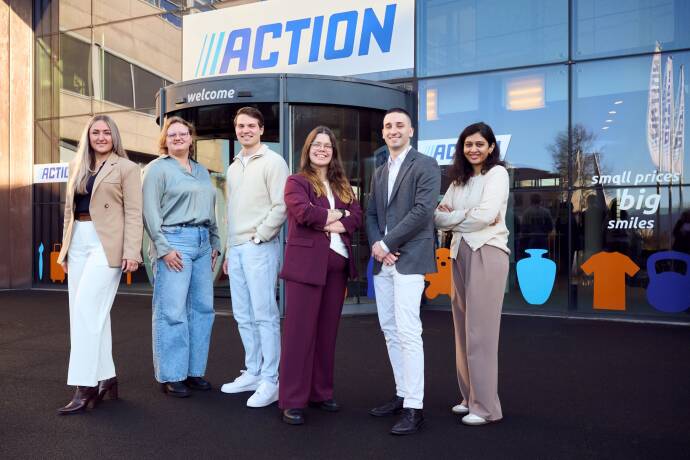
Our distribution centres (DCs) throughout Europe are key to our supply chain and keep Action moving. We invest in leadership and training programmes for our DC colleagues, supporting both their growth and the continuous improvement of these essential operations.
Developing leaders in our supply chain
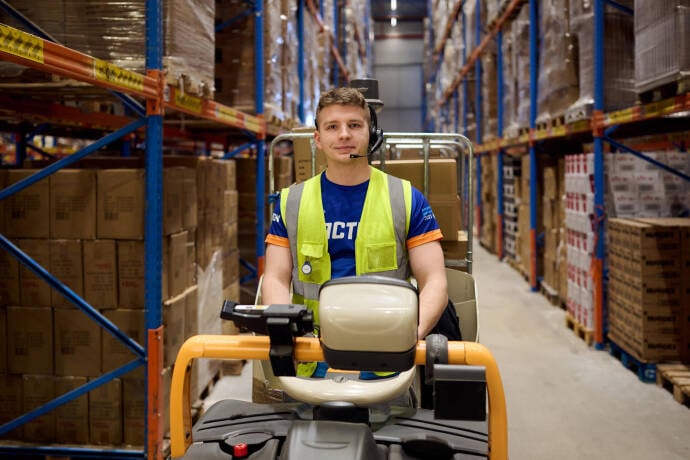
All Action colleagues have access to training so they can reach their full potential. This ranges from developing skills such as how to operate machinery or cash tills to mandatory training in health and safety. We also offer more specialised personal and leadership development programmes.
In 2025, we launched our first senior traineeship programme in store operations and finance, and our second junior programme, which offers an 18-month traineeship in commerce, store operations, supply chain management, marketing, finance, real estate or HR. During the year, we also extended our store operations senior traineeship to candidates in countries outside the Netherlands.
Training and development
In 2025, more than 90% of colleagues completed our latest Voice of Action survey.
Our commitment to a fair workplace means offering wages and benefits that are competitive and reflect employees’ contributions to Action. Action regularly benchmarks salaries and benefits against those paid by other, comparable employers.
We ensure continued compliance with all national minimum wage legislation, and labour rights and social protection. We have also started work on the EU’s Pay Transparency Directive.
Wages and benefits
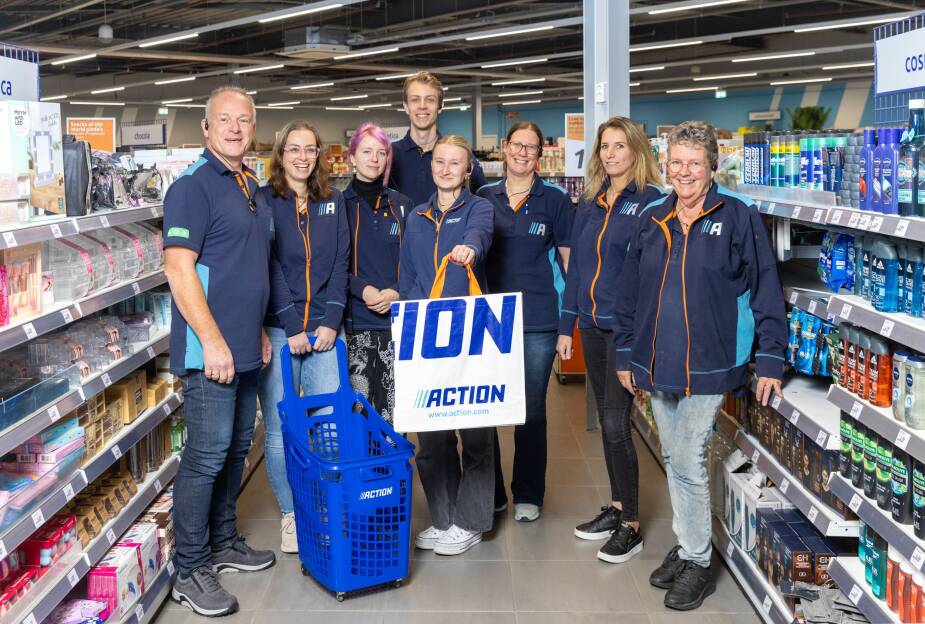
Every two years, we measure employee engagement through our company-wide survey, the Voice of Action. Every colleague gets 30 minutes of paid time and a secure platform to complete the anonymised survey.
This survey helps us to fine-tune our policies and business plans, as our colleagues know better than anyone what they and their teams need to experience Action as a great place to work. This survey also makes clear that we highly value everyone’s well-being, experiences, thoughts and suggestions for improvements.
In 2025, the participation of colleagues in the survey grew for the third year in a row, with a response rate of more than 90%. The response rate and the survey results show our colleagues are engaged and proud to be part of a successful company. They like our entrepreneurial spirit and team culture, the good work-life balance and the clarity of expectations. In general, they feel appreciated and they experience positive relationships with their managers. The survey also identified areas for improvement. All relevant suggestions and feedback will be followed up by our management and translated into detailed action plans to further improve our work environment.
Voice of Action
We want to ensure a safe and healthy work environment for everyone in every role, including contractors and visitors.
Our approach to health and safety is based on regular risk assessments across all operations, reinforced by audits and inspections. We are committed to complying with all relevant health and safety regulations. Through our Health and Safety Policy, we commit to minimising risks of injury or accidents.
We provide mandatory health and safety training to all our colleagues and contractors to ensure they understand the risks associated with their tasks and know how to prevent work-related injuries. Those working in DCs receive job-specific training.
Every year, to raise awareness of safety matters, Action organises a Safety Week (covering safety processes) and a Vitality Week (promoting well-being). We also participate in a Security Week (advising colleagues on personal safety).
Speaking up
We want our colleagues to feel safe speaking up about incidents of misconduct. Action colleagues can raise concerns with their manager and HR representative, or through our dedicated Alert Line. This Alert Line allows colleagues to report incidents 24/7 in their own language and anonymously if they prefer.
In 2025, we launched an awareness campaign for the Alert Line, including stepping up communications and providing additional training to managers. We also updated our Speak Up Policy to ensure compliance with EU whistleblower regulations, and extended the Alert Line to customers, contractors and others doing business with Action.
Workplace health and safety
We focus on creating equal opportunities and a supportive workplace where everyone can feel valued and grow. In 2025, this commitment was recognised across Europe with awards in multiple countries.
Employment awards
We are committed to reducing our climate impact and protecting the environment.
Building on the
ASP pillar Planet
Over the past five years, we have reduced greenhouse gas emissions from our own operations by 56%, mainly thanks to increased energy efficiency and a switch to renewable sources.
242
2025
199
2024
Electricity
(million kWh)
26
2025
31
Gas
(million kWh)
2024
1 A small number of stores use externally provided heating (e.g., district heating), and their energy source is unknown.
2 For further information, see www.co2emissiefactoren.nl.
We are taking steps to reduce greenhouse gas (GHG) emissions from both our own operations and our wider value chain. Our near-term GHG emission targets are validated by the Science Based Targets initiative (SBTi).
Focusing on greenhouse gas emissions caused by our own operations, we are reducing our energy consumption where possible and are switching to renewable electricity in our stores and DCs.
All1 our stores are gas-free. Our new DCs will operate in the same way. Many DCs also have solar panels or space to install them in the near future. We are also working with store landlords to install solar panels where possible. In addition, we have upgraded our fleet of Action trucks in the Netherlands to HVO 100, a renewable diesel that reduces emissions by up to 90% compared with conventional diesel.2 In 2026, we will continue to explore options to make our transport more sustainable.
We are committed to sourcing electricity as sustainably as possible. Renewable sources provided 90% of the electricity we use in our stores and DCs in 2025.
As we move away from gas to heat our stores and DCs, and gradually switch to electric trucks, our electricity consumption is expected to increase. We are therefore also focusing on energy efficiency. Smart meters, sensors and building management systems are helping us optimise our electricity consumption.
In February 2025, Action’s near-term science-based emissions reduction targets were validated by the Science Based Targets initiative (SBTi). That means the targets are in line with the 2015 Paris Agreement’s objective of limiting global warming to 1.5°C. Progress towards our target has been faster than expected. As a result, we were able to raise our reduction target later in the year to 75%, up from the original 60% (from our 2021 baseline).
Lowering our greenhouse gas emissions
Scopes 1 and 2 refer to greenhouse gas emissions from our own operations, such as energy consumption in our stores, distribution centres and offices, and fuel for our trucks. Scope 3 refers to emissions from our wider value chain, including the manufacturing and transport of products (upstream), as well as their use and disposal (downstream). For formal definitions, please refer to the Greenhouse Gas Protocol.
Even as we continue these efforts regarding our own operations, we recognise that almost all of Action’s GHG emissions originate from our wider value chain. As we have grown in recent years, so have these GHG emissions. These indirect, so-called scope 3 emissions occur during manufacturing, in the transportation of our products, and through customer use and waste disposal.
In 2025, we began working with our suppliers on climate action. As a first step, we are engaging with our suppliers to set science-based targets. At the end of 2025, 15% of Action’s suppliers in scope (as measured by emissions) had validated near-term science-based emissions targets in place. Our objective is that by 2029, suppliers representing 80% of our scope 3 emissions1 will have set science-based targets. To achieve this, we will be working closely with suppliers, providing guidance and support where possible.
We are already partnering with our ocean carriers to reduce the environmental impact of shipping products from suppliers in Asia to Action DCs in Europe. Since 2023, we have been sourcing certified biofuels for some of the fuel our ocean shipments consume. These biofuels offer a renewable, low-carbon alternative to fossil fuels, reducing our greenhouse gas emissions. In 2025, 50% of our containers for direct sourcing were shipped with biofuels, bringing the total emissions saved (compared with standard fossil fuels) to 50,161 tonnes of CO2 equivalent in 2025.
Cooperating with our supply chain
12.2%
Product use
and disposal
(3.11 and 3.12)
3.1%
Upstream and downstream transport
(3.3, 3.4 and 3.9)
3.9%
Capital goods (3.2)
16.1%
Other emission categories (scope 3)
0.2%
Own operations
(scope 1 and 2)
64.5%
Purchase of
products from suppliers (3.1)
Greenhouse gas emissions across Action’s value chain
Biodiversity is important to our business. Action relies on the natural world to provide materials for our products, as well as for maintaining healthy ecosystems and resilient supply chains.
We already have initiatives that help protect biodiversity and conserve natural resources. These include our policies on responsible sourcing, as well as our efforts to reduce emissions and waste and to promote the use of recycled materials.
Biodiversity is a highly complex topic that requires time and attention to formulate an effective strategy, recognising the significant challenges involved. In 2025, we commissioned our first detailed biodiversity impact and dependency assessment. In the coming years, we will use the results to further integrate biodiversity into our Action Sustainability Programme.
Climate change could affect our business directly. One of the biggest risks is extreme weather like storms and floods. These could disrupt deliveries of our products, or force DCs to close.
Our business model helps us manage these risks. Only one-third of our product range is fixed. That allows us to switch to other products when necessary, if supplies are disrupted. Sourcing from a variety of suppliers also makes our operations more resilient to the possible effects of climate change.
In addition, our distribution network has the capacity and operational flexibility to continue to supply stores should one or more DCs be forced to close. We also make sure that climate resilience is built into the design of all our DCs.
Action marked the official opening of its first gas-free DC at Illescas in central Spain in June 2025. Illescas has been certified ‘Outstanding’ by BREEAM, one of the most widely recognised environmental standards for buildings.
A new generation of Action distribution centres
Managing climate risks
Protecting nature

In 2025, we made significant progress within the Product pillar of the ASP. This covers the quality, safety and sustainability of our products and packaging, as well as labour and human rights in our supply chain.
Building on the
ASP pillar Product
While we offer the lowest prices to our customers, we are also constantly looking for ways to improve our products by making them more durable, easier to repair or recycle, and their packaging more sustainable.
A solid quality process
Our first priority is to ensure all Action products are of good quality. We have dedicated quality and safety teams working across our business, supported by a system of strict quality tests, inspections and controls. This work begins as soon as we identify a product we would like to sell.
Constantly improving
Action conducts regular checks to make sure all products meet rigorous safety and quality standards. There are some products where closer scrutiny and controls are necessary. These include toys for young children under the age of three.
Testing teddy bears
At all times, the safety of our customers and colleagues is our top priority. If, despite our best efforts, we find that products pose a risk to customers, or fail to meet requirements, they may be withdrawn.
When a product is withdrawn, we inform authorities and the public immediately. We also instruct customers on how to recognise the product and how to return it or dispose of it safely.
We make a distinction between silent withdrawals, resulting from a technical deficiency such as an incorrect label, and public safety withdrawals, where there may be a risk to the health and safety of customers. In 2025, we recorded 9 public safety withdrawals.
Recalls
We apply the same strict quality and safety standards to all our products, regardless of their origin.
All suppliers must adhere to Action’s Product Safety Policy. This means ensuring that:
all products are fit for purpose and comply with the relevant regulations;
the same safety and quality standards are also applied to their suppliers and contractors;
they document all quality assurance processes, train their employees and keep proper records.
For most suppliers, we carry out on-site audits. In-line inspections are conducted before, during and after production. All containers are inspected when leaving a factory, and once again when products reach Action DCs. We also have products tested at internationally recognised laboratories.
Every product, whether sourced directly from factories or via wholesalers and importers, undergoes rigorous testing and documentation aligned with Action’s internal standards as well as EU safety regulations.
All private label and directly sourced products have a technical file. This contains all required test reports, safety data sheets and declarations of conformity.
For specific categories, we carry out additional testing. Electrical products, for example, must meet the GS-Mark safety standard, while toys undergo more frequent testing to ensure they are safe for children (see opposite).
Timber
Timber used in our products comes from sustainably managed forests, certified by the Forest Stewardship Council® (FSC®) or the Programme for the Endorsement of Forest Certification (PEFC).
Coffee
Coffee sold by Action is certified as sustainable by Rainforest Alliance (RFA).
Palm oil
Our Zenova sun care products, including sunscreen, aftersun, sun lotion and sun milk, are either made with 100% RSPO-certified palm oil (and derivatives) or do not contain palm oil at all.
Sustainable sourcing
Cotton
Cotton used in our products is sustainably sourced under the Better Cotton programme, organic or recycled. A key example is our own Hotel Royal towel range, which is made from 100% cotton or blends with cotton satin or jersey. All materials are more responsibly sourced through Better Cotton.
Cocoa
Cocoa used in Action products is certified as sustainable by Fairtrade International, or by other recognised standards.
These certifications apply to more than 99% of Action’s private and white label products in scope based on type, volume sold or weight.
Many of our products are made using natural materials. We have a responsibility to use these resources in a sustainable way. More than 99% of all cotton, cocoa, timber, coffee and palm oil used in Action’s private and white label products is certified sustainable.
In most instances, these certifications are printed on product labels or packaging, allowing our customers to instantly recognise that the materials have been sustainably sourced.
By working with independent and recognised certifiers like the Better Cotton Initiative and the Roundtable on Sustainable Palm Oil, customers can be confident that our cotton is produced without using hazardous pesticides, for example, and that our palm oil comes from plantations that protect the world’s forests and other vital ecosystems.
We are always looking for opportunities to make our products more sustainable. This means working hand in hand with our suppliers, product by product.
A blender built to last

We are constantly looking for opportunities to make our products longer lasting, or easier to repair and recycle. To make these improvements, we listen closely to customers and suppliers to understand their experience with products. Whatever improvements we make, we always maintain our lowest price promise.
Making our products more durable, easier to repair or recycle also means we can use resources more efficiently, reduce our reliance on non-renewable materials and keep waste to a minimum.
We want to increase the circularity of all product categories, paying particular attention to products that consume the most resources. With this approach, we have made significant progress in recent years, especially in our linen, household goods and garden & outdoor ranges. We increasingly communicate about these product improvements and provide our customers with insights into the sustainable characteristics of our products.
Making improvements to our products requires close collaboration with our suppliers. In 2025, we launched a new supplier outreach programme to help improve overall product circularity.
Circularity and continuous improvement
We recognise that plastics play a vital role in society. Action uses plastics in a range of products, from household goods to multimedia and decorations. However, we are aware that plastics may cause environmental damage if not recycled or processed properly.
For that reason, we are committed to using plastics responsibly. By year-end 2025, our plastic products in scope contained 37% recycled material, ahead of our target of 35% by 2025. From 2026, all the recycled plastic we use in Action’s private and directly sourced import products will be independently certified under the Global Recycled Standard or Recycled Claim Standard labels.
Microplastics are widely used in personal care products, but they can cause harm to the environment. Action is eliminating microplastics where possible.
Caring for babies, caring for the planet
Recycled and circular products
Action sells products made entirely from recycled materials, for example, our Action shopper bag, Spectrum floor cover and Studio Home flannel throw. We are also turning our waste into new, circular products. Our waste management programmes are based on effective separation, collection and recycling. Cardboard and plastic are compressed at our DCs and then sent to recycling facilities. We use these materials for 100% circular products, like the bin bags and bins we introduced in 2025.
29%
From 2019 to 2025, we reduced the amount of packaging (by weight) used in our fixed range products by 29%.
Moving to sustainable packaging is an important part of our efforts to minimise our impact on the environment. We are committed to reducing packaging waste by decreasing both the amount and weight of our packaging.
We have eliminated all non-recyclable packaging and are replacing plastic where possible with more sustainable materials, such as fibre-based materials or FSC or PEFC-certified paper and cardboard.
In 2025, we also phased out the use of hard-to-recycle PVC and black plastics in our packaging, and we are working with suppliers to ensure compliance with the EU’s future packaging regulation.
All Action’s primary packaging (the packaging in direct contact with the product) is now fully recyclable, and all cardboard used in the packaging of Action’s private and white label products is certified sustainable.
Sustainable packaging
To help protect the environment, we are reducing our use of non-renewable materials, which often end up as waste. One example is our Noodlicious instant noodles
From plastic to paper for Noodlicious instant noodles
In 2025, a new Curver refuse bin went on sale in our stores. The bin is made from plastic collected at our DCs.
Making a refuse bin from recycled waste
Action is expanding its range of products for pets and making more use of sustainable materials at the same time.
A plush bed for pets with 100% recycled filling

96%
3 Risk countries are defined by the amfori BSCI Country Risk Classification
In 2025, we carried out 2,739 assessments, including both social audits and spot checks. That is over 96% of the factories we work with in risk countries.3 Our goal is to increase this figure to
100% in 2026.
Thousands of people around the world make products for Action. It is our responsibility, along with our suppliers, to make sure they have decent working conditions. We buy only from suppliers who respect human and labour rights.
We apply the same strict standards to all suppliers, from the smallest garment factory to the largest toy manufacturer, regardless of how long they have been working with us.
Standards for suppliers are set out in Action’s Ethical Sourcing Policy. This policy is based on UN principles and international labour standards. We require our suppliers to comply with these standards and we expect them to share the standards with their own suppliers and business partners. In this way, we help protect the rights of workers in the wider industry.
Our Ethical Sourcing Policy includes zero tolerance for child and forced labour, among other things, as well as provisions for health and safety, non-discrimination, and fair pay.
When sourcing from countries with an elevated risk of human rights violations, we align ourselves to UN and key NGO partners' recommendations and governance, and comply with applicable economic sanctions and trade restriction laws and regulations.
We regularly assess our suppliers to ensure compliance with our standards. In risk countries, we take additional measures, including social audits and spot checks in factories, to make sure workers’ rights are respected.
Labour and human rights in our supply chain
Some suppliers use homeworkers to help make products such as handmade decorative items.
Protection for homeworkers
Value chain transparency
To help protect the rights of workers, we need to know where our products are made and by whom. Our supply chain involves a significant number of wholesalers, factory workers, farmers, producers, agents and importers. By the end of 2025, we had mapped 97% of factories handling the final stage of production, a total of more than 3,900 factories worldwide. In 2026, we plan to further extend this transparency to factories involved in earlier stages of production. Our aim is to achieve full value chain transparency for private and white label products by 2030 at the latest.
Throughout this process, we work with our suppliers, providing training and advice, so they can make necessary improvements. As a last resort, we may exclude suppliers or delist products if we believe the risks to workers are too great. If a factory fails an audit, we do not place new orders until we can be sure the problem has been resolved.
In addition to our Ethical Sourcing Policy, we have a complementary Child Labour Policy and a Critical Escalation Policy, which sets out how we handle critical breaches of our standards. Our responsible sourcing policies on cocoa, cotton, palm oil and timber also require suppliers to protect internationally recognised human and labour rights.
We are developing new detailed policies on the use of forced labour, homeworking and protecting health and safety in factories and other sites, to ensure suppliers know exactly how to operate in line with our ethical sourcing standards.
Fair pay is a core part of Action’s Ethical Sourcing Policy. We respect minimum wage legislation, and we expect our suppliers to do the same.
Handling a critical incident in Pakistan
From time to time, we may receive reports of critical incidents related to human and labour rights. These incidents relate to serious breaches of our standards, for example, incidents of bribery, inhumane treatment, child labour or severe health and safety issues.
We investigate all reported incidents. As soon as an incident is substantiated, we suspend all shipments from the supplier and set about fixing the problem. We do this in close cooperation with the supplier. Action may disengage if a supplier fails to cooperate or further critical cases are reported, depending on their severity. In cases of child labour, we work closely with experts from the Centre for Child Rights and Business. In 2025, we registered 14 critical labour rights incidents. Most of these related to health and safety violations. The incidents are in scope for disclosure based on the results of our double materiality assessment (see the PDF version of our report for details on our material topics).
It is important to us that people working in our supply chain have a voice. Misconduct or violations of our standards can be reported anonymously and without fear of retaliation through our Speak for Change or FaceUp platforms. Our own Alert Line is also open to workers at direct sourcing suppliers and wholesalers to report incidents on Action premises.
Critical human and labour rights cases
Action wants to contribute to the communities where we operate. We focus on children, as they are the future and we believe children deserve a safe and healthy start in life. Over the years, we have worked closely with our partners SOS Children’s Villages and the Johan Cruyff Foundation.
In 2025, we added a new partnership with the Princess Máxima Foundation, which specialises in research and treatment of childhood cancers.
Building on the ASP pillar Partnership
Johan Cruyff Foundation
Through our partnership with the Johan Cruyff Foundation, we support sports and play opportunities for children. The Foundation creates safe, accessible spaces where children and young people can play, exercise and develop through sport.
The first Action-supported Cruyff Court opened in Paris in 2025. In the coming years, more Cruyff Courts will be built near Action stores in countries including the Netherlands, France, Germany, Spain and Belgium, helping support local communities and encouraging an active lifestyle among children.
Princess Máxima Center Foundation
Based in the Netherlands, the Princess Máxima Center Foundation has a global reach through a network of partners specialising in childhood cancer research, diagnostics and treatment. Through this new partnership, Action will support the Foundation’s core mission: to cure every child with cancer.
This partnership will formally launch across the countries where Action operates from 2026.
Fairtrade Living Income
Under our partnership with Fairtrade, all private label chocolate sold at Action is Fairtrade certified, and since 2022 we have paid an additional premium for the cocoa used in our private label products.
In 2025, Action became the first international retailer to commit to a special Fairtrade Living Income Cocoa Fund. The fund supports three cocoa cooperatives in Ivory Coast, helping farmers move towards earning a living income. The fund can be used for improving farming techniques or providing education opportunities for local children, supporting more sustainable livelihoods in cocoa-growing communities.
SOS Children’s Villages
We have been working with SOS Children’s Villages since 2018, providing care for children and young people, often those without or at risk of losing family support. Our support is directly linked to the number of Action stores and distribution centres, meaning that as Action grows, so does our contribution.
Historically, our support has mainly focused on Asia, where Action has a strong supplier base. In 2025, we began extending our partnership into Europe, bringing our support closer to the communities where we operate our stores. Through this partnership, Action supported 17,491 children in 2025.